Kyiv Seeks Safe-Navigation Guarantees as Black Sea Grain Shipping Stalls
Ukraine's foreign minister says proposals to restore freedom of navigation have gone to partners and Moscow, with the scope of any truce — including oil strikes — still unresolved.
How they tell it
13%12 outlets · 7 languages
1 critical, 6 neutral, none favorable
Other sourcesCritical
Kyiv sets the terms and Moscow is asked to answer; the Kremlin's reply is weighed and found wanting.
SEA Southeast Asian pressNeutral
Kyiv speaks, Moscow's condition is noted in a single clause, and the announcement is treated as a plain diplomatic fact.
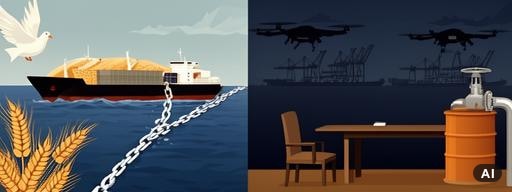
Ukraine has sent foreign partners a proposal for a ceasefire in the Black Sea intended to restore freedom of navigation and keep agricultural exports moving, and is waiting for a Russian answer. Foreign Minister Andrii Sybiha announced the step on 27 November at the fifth Food from Ukraine conference in Kyiv, saying: "We are ready for a ceasefire." According to Libnanews, the text has not been published and no agreement has been announced, and no date has been set for a Russian response.
Mr Sybiha thanked India, Turkey and Egypt for what he described as an active and important role in de-escalating tensions in the Black Sea and in mediation, and said all Ukrainian proposals had been conveyed. According to the Ukrainian minister, Moscow has asked that a halt to Ukrainian strikes on the Russian oil sector be written into the arrangement — a condition Kyiv describes as unrealistic and says it would discuss only within a wider energy ceasefire covering attacks on both countries' energy infrastructure. Speaking in the Ukrainian capital, Mr Sybiha framed the initiative around agricultural produce and navigation rather than oil.
The offer comes against a collapse in commercial traffic. According to Ukrainian authorities, Russian drones attacked two foreign cargo ships carrying grain off Odesa on 26 November. Shipping in the north-western Black Sea has all but stopped in recent months, with major shipowners declining to send vessels because of the risk of destruction and sharply higher insurance costs. Ukrainian forces, for their part, have intensified strikes on Russian refining since late October; by mid-November, 15 of 35 large refineries had been targeted and refining volumes had fallen by 45 per cent, a figure the reports did not source. On 27 November the Russian government banned aviation kerosene exports until spring. Ukrainian analysts say Russian forces have carried out more than 1,000 strikes on Ukrainian power stations and substations since September, forcing Kyiv to halt electricity exports.
The 2022 grain initiative offers at most a rough guide to the present offer. Negotiated by Turkey and the United Nations and signed in Istanbul on 22 July, it allowed exports from three Ukrainian ports under an Istanbul coordination centre; the UN recorded 32.8 million tonnes exported before Russia declined to extend it on 17 July 2023. According to Libnanews, that precedent gives an order of magnitude but not the mechanism for the current proposal, whose scope, covered ports and verification arrangements remain undefined. The leaders of Germany, France, Britain and Ukraine called on 19 November for a Black Sea ceasefire guaranteeing safe passage and freedom of navigation. Kyiv had already raised a Black Sea truce and a mutual halt to energy strikes at trilateral talks in Abu Dhabi in early November. The next step is a Russian response to the proposals; no timetable has been given.
The Divergence across 7 points of view
- Critical: Other sources
- Neutral: EUR, TUR, ALM, IRN, RUS, SEA
- Favorable: no bloc
- Pale: the bloc has no reading of this story
Bloc by bloc, from the most critical to the most favourable
Other sourcesCritical
Reading
Kyiv sets the terms and Moscow is asked to answer; the Kremlin's reply is weighed and found wanting.
Description
Kyiv's Black Sea truce offer is framed as a test of Moscow's willingness to compromise, with the Kremlin's counter-conditions treated as unrealistic. The report widens to strikes on shipping near Odesa, a first laser interception of a jet drone and a public rupture between Kyiv and Washington over calling Putin a friend. Russia stays the side that blocks a deal.
Mechanismoutsourced verdict
Judgement is outsourced: 'unrealistic' arrives both as Kyiv's charge and as a think-tank finding, and the case is closed with a run of corroborating incidents rather than an argument.
EUR Continental European pressNeutral
Reading
Kyiv's grain corridor is defended as a global food supply line, and Washington's even hand toward Moscow is questioned by Kyiv itself.
Description
The offer is reported as a food-security and shipping necessity, set against an attack on two grain carriers off Odesa and a port traffic that has all but stopped since late July. Kyiv's strained ties with Washington and the Kremlin's rebuke of Zelensky run alongside the truce news. The emphasis sits on consequences rather than on the terms of any truce.
Mechanismconsequence stacking
Consequences are stacked first — insurers, halted shipments, nine tenths of exports through three ports — so the truce reads as urgent before its terms are examined.
TUR Turkish pressNeutral
Reading
Ankara's mediation is placed at the centre of a deal between two other parties, and the truce is judged by the diplomatic weight it displays.
Description
The truce offer becomes a diplomatic credit story: Ankara's and New Delhi's mediation is thanked in the section headings and the grain corridor is tied to Turkey's earlier role, with trade reported at a sixteen-year low. Moscow's oil condition is described as a condition Kyiv did not answer inside this proposal, and a Russian defence-ministry account of strikes on power, fuel and rail is set against Ukrainian drone raids toward Moscow. It closes with Rome warning Kyiv that support does not cover actions endangering Italy and the Mediterranean.
Mechanismmediator centrality
The mediator is written into the section headings, and a closing rebuke from an ally keeps the register from reading as one-sided advocacy.
ALM Arab Levant-Maghreb pressNeutral
Reading
Kyiv announces, Moscow attaches a condition, the region's mediators are thanked, and the substance of any deal is left open.
Description
The statement is carried mostly as short bulletins, with the Russian condition on oil given headline status and Kyiv calling it unrealistic. One longer piece insists that no text was published and no accord announced, listing what a truce would still have to define: which ships, which ports, who records violations. Turkey, Egypt and India are credited as mediators, and one item adds a claim about grain taken from territory it calls occupied; several sampled texts are short extracts.
Mechanismprocedural anchoring
The breakthrough is proceduralised: naming what a truce would still have to settle — published text, covered vessels, verification — keeps the announcement at the level of an intention.
IRN Iranian & allied pressNeutral
Reading
Kyiv's offer arrives through a chain of broadcasters and agencies, the oil clause is handled as a technical question, and Washington is gently faulted for even-handedness.
Description
The proposal is relayed as a safeguard for grain exports, credited to a news agency citing regional broadcasters, with earlier Turkish and Indian mediation recalled. Moscow's wish to add oil exports is explained as a question for a wider energy truce rather than as a rejection. The item closes on Ukrainian irritation at Washington's even-handedness, and on the note that the outlet reproduces official media output.
Mechanismchained attribution
Statements are routed through other broadcasters and agencies, so the item reads as monitored news, and the contested oil clause becomes a question about a technical annex.
RUS Russian & CIS pressNeutral
Reading
Both capitals are shown striking each other's trade and fuel systems, and the truce is measured against that symmetry.
Description
The offer is relayed in the foreign minister's words and immediately matched with a mirror ledger: Ukrainian strikes on refineries, a 45 percent fall in refining, a jet-fuel export ban, over a thousand strikes on Ukrainian power sites. Trade and energy infrastructure are described as hit from both sides, so the truce becomes a shared de-escalation problem. The register stays flat and quantitative, and similar wire copy circulates across the sampled regional outlets.
Mechanismsymmetrical escalation
Every Ukrainian demand draws a Russian counter-fact and a percentage, and the oil clause is reframed as a technical annex to a wider energy deal, so blame dissolves into arithmetic.
SEA Southeast Asian pressNeutral
Reading
Kyiv speaks, Moscow's condition is noted in a single clause, and the announcement is treated as a plain diplomatic fact.
Description
A compact agency bulletin: the foreign minister's statement, the goal of restoring navigation and uninterrupted farm exports, and the note that Russia wants oil provisions inside the deal. No strikes, no casualty claims, no alliance friction appear. Scope, dates and verification are left unaddressed, and the stored text is a short extract.
Mechanismwire compression
Radical compression: only the official statement and its declared aims survive, so nothing contested enters the text.
Neither Ukrainian nor Russian outlets are sampled in this cluster; Kyiv and Moscow appear only through statements quoted by third parties.
This story appeared in
🇱🇧Lebanon3
🇨🇿Czechia1
🇫🇷France1
🇮🇷Iran1
🇰🇬Kyrgyzstan1
🇰🇭Cambodia1
🇰🇿Kazakhstan1
🇸🇾Syria1
🇹🇷Türkiye1
🇺🇿Uzbekistan1
On the same topic
Broaden your view
Kyiv Seeks Safe-Navigation Guarantees as Black Sea Grain Shipping Stalls
Ukraine's foreign minister says proposals to restore freedom of navigation have gone to partners and Moscow, with the scope of any truce — including oil strikes — still unresolved.
Ukraine has sent foreign partners a proposal for a ceasefire in the Black Sea intended to restore freedom of navigation and keep agricultural exports moving, and is waiting for a Russian answer. Foreign Minister Andrii Sybiha announced the step on 27 November at the fifth Food from Ukraine conference in Kyiv, saying: "We are ready for a ceasefire." According to Libnanews, the text has not been published and no agreement has been announced, and no date has been set for a Russian response.
Mr Sybiha thanked India, Turkey and Egypt for what he described as an active and important role in de-escalating tensions in the Black Sea and in mediation, and said all Ukrainian proposals had been conveyed. According to the Ukrainian minister, Moscow has asked that a halt to Ukrainian strikes on the Russian oil sector be written into the arrangement — a condition Kyiv describes as unrealistic and says it would discuss only within a wider energy ceasefire covering attacks on both countries' energy infrastructure. Speaking in the Ukrainian capital, Mr Sybiha framed the initiative around agricultural produce and navigation rather than oil.
The offer comes against a collapse in commercial traffic. According to Ukrainian authorities, Russian drones attacked two foreign cargo ships carrying grain off Odesa on 26 November. Shipping in the north-western Black Sea has all but stopped in recent months, with major shipowners declining to send vessels because of the risk of destruction and sharply higher insurance costs. Ukrainian forces, for their part, have intensified strikes on Russian refining since late October; by mid-November, 15 of 35 large refineries had been targeted and refining volumes had fallen by 45 per cent, a figure the reports did not source. On 27 November the Russian government banned aviation kerosene exports until spring. Ukrainian analysts say Russian forces have carried out more than 1,000 strikes on Ukrainian power stations and substations since September, forcing Kyiv to halt electricity exports.
The 2022 grain initiative offers at most a rough guide to the present offer. Negotiated by Turkey and the United Nations and signed in Istanbul on 22 July, it allowed exports from three Ukrainian ports under an Istanbul coordination centre; the UN recorded 32.8 million tonnes exported before Russia declined to extend it on 17 July 2023. According to Libnanews, that precedent gives an order of magnitude but not the mechanism for the current proposal, whose scope, covered ports and verification arrangements remain undefined. The leaders of Germany, France, Britain and Ukraine called on 19 November for a Black Sea ceasefire guaranteeing safe passage and freedom of navigation. Kyiv had already raised a Black Sea truce and a mutual halt to energy strikes at trilateral talks in Abu Dhabi in early November. The next step is a Russian response to the proposals; no timetable has been given.
The Divergence across 7 points of view
- Critical: Other sources
- Neutral: EUR, TUR, ALM, IRN, RUS, SEA
- Favorable: no bloc
- Pale: the bloc has no reading of this story
Other sourcesCritical
Reading
Kyiv sets the terms and Moscow is asked to answer; the Kremlin's reply is weighed and found wanting.
Description
Kyiv's Black Sea truce offer is framed as a test of Moscow's willingness to compromise, with the Kremlin's counter-conditions treated as unrealistic. The report widens to strikes on shipping near Odesa, a first laser interception of a jet drone and a public rupture between Kyiv and Washington over calling Putin a friend. Russia stays the side that blocks a deal.
Mechanismoutsourced verdict
Judgement is outsourced: 'unrealistic' arrives both as Kyiv's charge and as a think-tank finding, and the case is closed with a run of corroborating incidents rather than an argument.
Bloc by bloc, from the most critical to the most favourable
Other sourcesCritical
Reading
Kyiv sets the terms and Moscow is asked to answer; the Kremlin's reply is weighed and found wanting.
Description
Kyiv's Black Sea truce offer is framed as a test of Moscow's willingness to compromise, with the Kremlin's counter-conditions treated as unrealistic. The report widens to strikes on shipping near Odesa, a first laser interception of a jet drone and a public rupture between Kyiv and Washington over calling Putin a friend. Russia stays the side that blocks a deal.
Mechanismoutsourced verdict
Judgement is outsourced: 'unrealistic' arrives both as Kyiv's charge and as a think-tank finding, and the case is closed with a run of corroborating incidents rather than an argument.
EUR Continental European pressNeutral
Reading
Kyiv's grain corridor is defended as a global food supply line, and Washington's even hand toward Moscow is questioned by Kyiv itself.
Description
The offer is reported as a food-security and shipping necessity, set against an attack on two grain carriers off Odesa and a port traffic that has all but stopped since late July. Kyiv's strained ties with Washington and the Kremlin's rebuke of Zelensky run alongside the truce news. The emphasis sits on consequences rather than on the terms of any truce.
Mechanismconsequence stacking
Consequences are stacked first — insurers, halted shipments, nine tenths of exports through three ports — so the truce reads as urgent before its terms are examined.
TUR Turkish pressNeutral
Reading
Ankara's mediation is placed at the centre of a deal between two other parties, and the truce is judged by the diplomatic weight it displays.
Description
The truce offer becomes a diplomatic credit story: Ankara's and New Delhi's mediation is thanked in the section headings and the grain corridor is tied to Turkey's earlier role, with trade reported at a sixteen-year low. Moscow's oil condition is described as a condition Kyiv did not answer inside this proposal, and a Russian defence-ministry account of strikes on power, fuel and rail is set against Ukrainian drone raids toward Moscow. It closes with Rome warning Kyiv that support does not cover actions endangering Italy and the Mediterranean.
Mechanismmediator centrality
The mediator is written into the section headings, and a closing rebuke from an ally keeps the register from reading as one-sided advocacy.
ALM Arab Levant-Maghreb pressNeutral
Reading
Kyiv announces, Moscow attaches a condition, the region's mediators are thanked, and the substance of any deal is left open.
Description
The statement is carried mostly as short bulletins, with the Russian condition on oil given headline status and Kyiv calling it unrealistic. One longer piece insists that no text was published and no accord announced, listing what a truce would still have to define: which ships, which ports, who records violations. Turkey, Egypt and India are credited as mediators, and one item adds a claim about grain taken from territory it calls occupied; several sampled texts are short extracts.
Mechanismprocedural anchoring
The breakthrough is proceduralised: naming what a truce would still have to settle — published text, covered vessels, verification — keeps the announcement at the level of an intention.
IRN Iranian & allied pressNeutral
Reading
Kyiv's offer arrives through a chain of broadcasters and agencies, the oil clause is handled as a technical question, and Washington is gently faulted for even-handedness.
Description
The proposal is relayed as a safeguard for grain exports, credited to a news agency citing regional broadcasters, with earlier Turkish and Indian mediation recalled. Moscow's wish to add oil exports is explained as a question for a wider energy truce rather than as a rejection. The item closes on Ukrainian irritation at Washington's even-handedness, and on the note that the outlet reproduces official media output.
Mechanismchained attribution
Statements are routed through other broadcasters and agencies, so the item reads as monitored news, and the contested oil clause becomes a question about a technical annex.
RUS Russian & CIS pressNeutral
Reading
Both capitals are shown striking each other's trade and fuel systems, and the truce is measured against that symmetry.
Description
The offer is relayed in the foreign minister's words and immediately matched with a mirror ledger: Ukrainian strikes on refineries, a 45 percent fall in refining, a jet-fuel export ban, over a thousand strikes on Ukrainian power sites. Trade and energy infrastructure are described as hit from both sides, so the truce becomes a shared de-escalation problem. The register stays flat and quantitative, and similar wire copy circulates across the sampled regional outlets.
Mechanismsymmetrical escalation
Every Ukrainian demand draws a Russian counter-fact and a percentage, and the oil clause is reframed as a technical annex to a wider energy deal, so blame dissolves into arithmetic.
SEA Southeast Asian pressNeutral
Reading
Kyiv speaks, Moscow's condition is noted in a single clause, and the announcement is treated as a plain diplomatic fact.
Description
A compact agency bulletin: the foreign minister's statement, the goal of restoring navigation and uninterrupted farm exports, and the note that Russia wants oil provisions inside the deal. No strikes, no casualty claims, no alliance friction appear. Scope, dates and verification are left unaddressed, and the stored text is a short extract.
Mechanismwire compression
Radical compression: only the official statement and its declared aims survive, so nothing contested enters the text.
Neither Ukrainian nor Russian outlets are sampled in this cluster; Kyiv and Moscow appear only through statements quoted by third parties.