Piura Streets Under Water as Rains Tied to El Niño Hit Peru and Ecuador
Peru's civil defence chief reports about 2,000 families affected in Piura after twelve hours of rain, while Ecuador's risk management secretariat counts 34 deaths and 47,000 people affected.
How they tell it
6%27 outlets · 8 languages
none critical, 8 neutral, none favorable
Read the divergences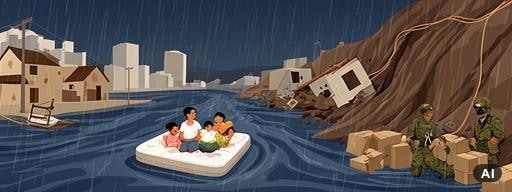
Twelve hours of heavy rain that began on Thursday left streets in Piura, capital of the northern Peruvian region of the same name, under waist-high water, with vehicles submerged. Luis Vásquez, head of Peru's National Institute of Civil Defence, told the RPP radio station that preliminary reports showed about 2,000 families affected. The agency flew five tonnes of humanitarian aid to the region, about 1,000 kilometres north of Lima, and General Carlos Rabanal of the Northern Operational Command said about 250 soldiers were involved and shelters had been opened, according to El Deber. EFE reported that about 400 people were rescued from flooded areas on 27 November and that one monitoring station in Piura recorded up to 143 millimetres of rain in 24 hours.
Ecuador's National Secretariat for Risk Management reported on Friday that 34 people had died and about 47,000 had been affected by heavy rains. In the coastal city of Manta, two rivers broke their banks; residents waded through chest-deep water and some floated on mattresses. "We've been soaking in mud for four days," Fernanda Navarrete, 41, told AFP, saying the sewers had burst and the stench was awful. The Ecuadorean outlet Primicias documented evacuations and two schools described as completely affected after a further overflow of the Manta River on 27 November.
Reporting diverges on the period the Ecuadorean death toll covers. Danas, citing the state risk agency, dated at least 34 deaths in Ecuador to the end of August, while reports carried by The Korea Times and Republica Nepal, drawing on Agence France-Presse, attributed them to the current rains. The figure of about 2,000 affected families in Piura rests on the civil defence chief's preliminary assessment.
President Keiko Fujimori postponed a trip to Colombia and said she would travel to the affected areas; Danas reported that she toured a flooded neighbourhood on Friday during a thunderstorm, warned that Peru faced a "mega El Niño" and said her government was coordinating assistance from the United States and China. Peru declared an emergency at the start of the month covering 1,380 of its more than 1,800 districts, and Cenepred, the national disaster risk centre, estimates that more than 9.3 million people, almost a third of the population, are exposed to high flood and landslide risk. Meteorologists extended a red alert for Piura and Tumbes until Monday, and El Niño would retain exceptional strength until February, according to Danas; Enfen, the government's technical commission, expects an event of extraordinary magnitude until February, easing until June. This year's episode is projected to be the strongest on record.
Heavy rain was forecast to continue in northern Peru through the weekend, EFE reported. The casualty and displacement figures remained provisional as rescue and relief operations continued.
The Divergence across 8 points of view
- Critical: no bloc
- Neutral: IND, EUR, AFR, GLF, LAT, ATL, CIN, GIAPPONE_COREA_TAIWAN
- Favorable: no bloc
- Pale: the bloc has no reading of this story
Bloc by bloc, from the most critical to the most favourable
IND Indian & South Asian pressNeutral
Reading
Residents of Piura take the floor and accuse: the first downpour found the authorities unprepared, and a nurse counts the children and elderly who cannot leave their homes.
Description
A South Asian outlet republishes the full wire account, keeping residents' accusations that authorities prepared nothing and a nurse's worry about children and the elderly, alongside the Ecuadorian toll of 34 dead and 47,000 affected. The climate explanation is a short paragraph between testimonies.
Mechanismtestimony as verdict
First-person testimony is left to carry the judgement, with official figures kept as backdrop rather than argument.
EUR Continental European pressNeutral
Reading
Officials and climate services set the terms: an extraordinary warming of the Pacific is becoming a standing emergency, and readers are asked to read it as a warning rather than a distant accident.
Description
Continental European coverage leads with death tolls and national emergency declarations, and several outlets widen the lens to man-made warming, a possible record-hot 2027 and shrinking humanitarian budgets. The episode is presented as an extraordinary-strength phenomenon lasting until February along an Andean coast already under red alert.
Mechanismforecast anchoring
Official tolls are quoted first, then layered with seasonal forecasts and warming context, so each figure doubles as a predictor.
AFR Sub-Saharan African pressNeutral
Reading
The flood is told through those standing in it: a man watches his refrigerator float, a retiree asks why nothing was prevented, and the official toll follows their voices.
Description
An East African broadcaster carries the wire report on flooded Piura and Manta, with the householder who lost everything, a retiree's complaint that nothing was prevented, and the Ecuadorian toll of 34 dead and 47,000 affected. The phenomenon is described briefly as the strongest on record.
Mechanismfirst-person synecdoche
Individual first-person loss stands in for the scale of the disaster, so a single floating appliance carries what a statistic otherwise would.
GLF Arab Gulf pressNeutral
Reading
An instructor sets the lesson: extreme water overwhelms cities without drainage and warning systems, so preparedness — not blame — is the point.
Description
Gulf outlets explain the flood: agency figures, a description of how warm Pacific water intensifies rainfall, and a closing emphasis on drainage, early warning and preparedness. One version is a condensed wire report, the other a didactic explainer with named sources.
Mechanismrisk-lesson framing
An explicit 'understanding the threat' segment converts a disaster report into a risk lesson, with each source named as it is used.
LAT Latin American pressNeutral
Reading
The region narrates itself: presidents walk flooded streets, an electoral calendar bends around the water, and the episode is measured against the great Niños remembered here.
Description
Regional outlets follow the floods city by city, fold in Ecuador's local elections moved forward and polling stations relocated, count 126,935 people affected and dozens of rivers overflowing, and measure the episode against the great Niños of 1982-83, 1997-98 and 2016-17. Presidential tours, emergency declarations and demands for climate adaptation sit side by side.
Mechanismregional memory benchmark
Proximity does the work: the disaster is placed inside a remembered lineage of past Niños and inside a live electoral calendar, so urgency comes from familiarity.
ATL Atlantic / Anglosphere pressNeutral
Reading
Rescuers, forecasters and a president touring by police boat carry the story: this is a live emergency whose bill will arrive in food prices and lost growth.
Description
Anglo-American coverage treats the floods as a live emergency: rescues, record rainfall in Piura and disrupted Ecuadorian elections, followed by economic fallout — food prices, inflation above 5%, lost growth into 2027. Officials, forecasters and residents carry the account, and the climate mechanism is explained in a line or two.
Mechanismcumulative detail
Scene-level detail — waist-high water, a rooftop rescue — is stacked against hard fiscal numbers, so scale is built by accumulation rather than argument.
CIN Chinese pressNeutral
Reading
A distant recorder registers the disruption: streets under water, families affected, a trip postponed — and stops there, taking no side.
Description
A short agency-derived bulletin records flooding in Piura and Manta, some 2,000 families hit and a postponed presidential trip, in a stored text of only a few hundred characters. The wider climate and economic context seen in other blocs is absent from what is available here, so the excerpt cannot support a broader frame.
Mechanismbulletin compression
Compression: a handful of verified figures and one official attribution carry the whole item.
GIAPPONE_COREA_TAIWANNeutral
Reading
A desk compiles rather than comments: the facts are numbered, attributed and closed, and no authorial stance is offered.
Description
An English-language Korean outlet presents a summary block and key-fact bullets — 2,000 families in Piura, 34 dead and 47,000 affected in Ecuador, a postponed presidential trip — before a condensed wire body. No wider climate or economic frame appears in the stored text.
Mechanismfact-sheet digest
A bulleted key-fact block precedes the wire body, so the reader meets the numbers before any narrative.
This story appeared in
🇫🇷France2
🇳🇴Norway2
🇵🇪Peru2
🇦🇷Argentina1
🇦🇹Austria1
🇧🇭Bahrain1
🇨🇱Chile1
🇩🇪Germany1
🇪🇸Spain1
Show all 27 outlets
🇬🇧United Kingdom1
🇭🇰Hong Kong SAR China1
🇮🇹Italy1
🇰🇪Kenya1
🇰🇷South Korea1
🇳🇵Nepal1
🇵🇦Panama1
🇵🇷Puerto Rico1
🇷🇸Serbia1
🇸🇦Saudi Arabia1
🇸🇷Suriname1
🇺🇸United States1
🇻🇪Venezuela1
On the same topic
Broaden your view
Piura Streets Under Water as Rains Tied to El Niño Hit Peru and Ecuador
Peru's civil defence chief reports about 2,000 families affected in Piura after twelve hours of rain, while Ecuador's risk management secretariat counts 34 deaths and 47,000 people affected.
Twelve hours of heavy rain that began on Thursday left streets in Piura, capital of the northern Peruvian region of the same name, under waist-high water, with vehicles submerged. Luis Vásquez, head of Peru's National Institute of Civil Defence, told the RPP radio station that preliminary reports showed about 2,000 families affected. The agency flew five tonnes of humanitarian aid to the region, about 1,000 kilometres north of Lima, and General Carlos Rabanal of the Northern Operational Command said about 250 soldiers were involved and shelters had been opened, according to El Deber. EFE reported that about 400 people were rescued from flooded areas on 27 November and that one monitoring station in Piura recorded up to 143 millimetres of rain in 24 hours.
Ecuador's National Secretariat for Risk Management reported on Friday that 34 people had died and about 47,000 had been affected by heavy rains. In the coastal city of Manta, two rivers broke their banks; residents waded through chest-deep water and some floated on mattresses. "We've been soaking in mud for four days," Fernanda Navarrete, 41, told AFP, saying the sewers had burst and the stench was awful. The Ecuadorean outlet Primicias documented evacuations and two schools described as completely affected after a further overflow of the Manta River on 27 November.
Reporting diverges on the period the Ecuadorean death toll covers. Danas, citing the state risk agency, dated at least 34 deaths in Ecuador to the end of August, while reports carried by The Korea Times and Republica Nepal, drawing on Agence France-Presse, attributed them to the current rains. The figure of about 2,000 affected families in Piura rests on the civil defence chief's preliminary assessment.
President Keiko Fujimori postponed a trip to Colombia and said she would travel to the affected areas; Danas reported that she toured a flooded neighbourhood on Friday during a thunderstorm, warned that Peru faced a "mega El Niño" and said her government was coordinating assistance from the United States and China. Peru declared an emergency at the start of the month covering 1,380 of its more than 1,800 districts, and Cenepred, the national disaster risk centre, estimates that more than 9.3 million people, almost a third of the population, are exposed to high flood and landslide risk. Meteorologists extended a red alert for Piura and Tumbes until Monday, and El Niño would retain exceptional strength until February, according to Danas; Enfen, the government's technical commission, expects an event of extraordinary magnitude until February, easing until June. This year's episode is projected to be the strongest on record.
Heavy rain was forecast to continue in northern Peru through the weekend, EFE reported. The casualty and displacement figures remained provisional as rescue and relief operations continued.
The Divergence across 8 points of view
- Critical: no bloc
- Neutral: IND, EUR, AFR, GLF, LAT, ATL, CIN, GIAPPONE_COREA_TAIWAN
- Favorable: no bloc
- Pale: the bloc has no reading of this story
IND Indian & South Asian pressNeutral
Reading
Residents of Piura take the floor and accuse: the first downpour found the authorities unprepared, and a nurse counts the children and elderly who cannot leave their homes.
Description
A South Asian outlet republishes the full wire account, keeping residents' accusations that authorities prepared nothing and a nurse's worry about children and the elderly, alongside the Ecuadorian toll of 34 dead and 47,000 affected. The climate explanation is a short paragraph between testimonies.
Mechanismtestimony as verdict
First-person testimony is left to carry the judgement, with official figures kept as backdrop rather than argument.
Bloc by bloc, from the most critical to the most favourable
IND Indian & South Asian pressNeutral
Reading
Residents of Piura take the floor and accuse: the first downpour found the authorities unprepared, and a nurse counts the children and elderly who cannot leave their homes.
Description
A South Asian outlet republishes the full wire account, keeping residents' accusations that authorities prepared nothing and a nurse's worry about children and the elderly, alongside the Ecuadorian toll of 34 dead and 47,000 affected. The climate explanation is a short paragraph between testimonies.
Mechanismtestimony as verdict
First-person testimony is left to carry the judgement, with official figures kept as backdrop rather than argument.
EUR Continental European pressNeutral
Reading
Officials and climate services set the terms: an extraordinary warming of the Pacific is becoming a standing emergency, and readers are asked to read it as a warning rather than a distant accident.
Description
Continental European coverage leads with death tolls and national emergency declarations, and several outlets widen the lens to man-made warming, a possible record-hot 2027 and shrinking humanitarian budgets. The episode is presented as an extraordinary-strength phenomenon lasting until February along an Andean coast already under red alert.
Mechanismforecast anchoring
Official tolls are quoted first, then layered with seasonal forecasts and warming context, so each figure doubles as a predictor.
AFR Sub-Saharan African pressNeutral
Reading
The flood is told through those standing in it: a man watches his refrigerator float, a retiree asks why nothing was prevented, and the official toll follows their voices.
Description
An East African broadcaster carries the wire report on flooded Piura and Manta, with the householder who lost everything, a retiree's complaint that nothing was prevented, and the Ecuadorian toll of 34 dead and 47,000 affected. The phenomenon is described briefly as the strongest on record.
Mechanismfirst-person synecdoche
Individual first-person loss stands in for the scale of the disaster, so a single floating appliance carries what a statistic otherwise would.
GLF Arab Gulf pressNeutral
Reading
An instructor sets the lesson: extreme water overwhelms cities without drainage and warning systems, so preparedness — not blame — is the point.
Description
Gulf outlets explain the flood: agency figures, a description of how warm Pacific water intensifies rainfall, and a closing emphasis on drainage, early warning and preparedness. One version is a condensed wire report, the other a didactic explainer with named sources.
Mechanismrisk-lesson framing
An explicit 'understanding the threat' segment converts a disaster report into a risk lesson, with each source named as it is used.
LAT Latin American pressNeutral
Reading
The region narrates itself: presidents walk flooded streets, an electoral calendar bends around the water, and the episode is measured against the great Niños remembered here.
Description
Regional outlets follow the floods city by city, fold in Ecuador's local elections moved forward and polling stations relocated, count 126,935 people affected and dozens of rivers overflowing, and measure the episode against the great Niños of 1982-83, 1997-98 and 2016-17. Presidential tours, emergency declarations and demands for climate adaptation sit side by side.
Mechanismregional memory benchmark
Proximity does the work: the disaster is placed inside a remembered lineage of past Niños and inside a live electoral calendar, so urgency comes from familiarity.
ATL Atlantic / Anglosphere pressNeutral
Reading
Rescuers, forecasters and a president touring by police boat carry the story: this is a live emergency whose bill will arrive in food prices and lost growth.
Description
Anglo-American coverage treats the floods as a live emergency: rescues, record rainfall in Piura and disrupted Ecuadorian elections, followed by economic fallout — food prices, inflation above 5%, lost growth into 2027. Officials, forecasters and residents carry the account, and the climate mechanism is explained in a line or two.
Mechanismcumulative detail
Scene-level detail — waist-high water, a rooftop rescue — is stacked against hard fiscal numbers, so scale is built by accumulation rather than argument.
CIN Chinese pressNeutral
Reading
A distant recorder registers the disruption: streets under water, families affected, a trip postponed — and stops there, taking no side.
Description
A short agency-derived bulletin records flooding in Piura and Manta, some 2,000 families hit and a postponed presidential trip, in a stored text of only a few hundred characters. The wider climate and economic context seen in other blocs is absent from what is available here, so the excerpt cannot support a broader frame.
Mechanismbulletin compression
Compression: a handful of verified figures and one official attribution carry the whole item.
GIAPPONE_COREA_TAIWANNeutral
Reading
A desk compiles rather than comments: the facts are numbered, attributed and closed, and no authorial stance is offered.
Description
An English-language Korean outlet presents a summary block and key-fact bullets — 2,000 families in Piura, 34 dead and 47,000 affected in Ecuador, a postponed presidential trip — before a condensed wire body. No wider climate or economic frame appears in the stored text.
Mechanismfact-sheet digest
A bulleted key-fact block precedes the wire body, so the reader meets the numbers before any narrative.