Explosion at explosives store beside Kunar school kills pupils; death toll disputed
Provincial and interior ministry officials give conflicting tolls of seven and ten dead after Saturday's blast at a mining explosives depot beside a school in Asadabad.
How they tell it
23%80 outlets · 18 languages
1 critical, 13 neutral, none favorable
Other sourcesCritical
Afghan independent reporters speak from inside a contested information space, siding with the families against an official account they present as unverifiable.
ATL Atlantic / Anglosphere pressNeutral
Anglophone correspondents stand at the hospital gate with the families, relaying rescuers' words and a children's agency's demand that schools be safe.
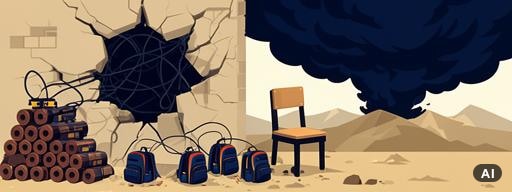
An explosion at a building beside a school in eastern Afghanistan on Saturday morning killed at least seven students and injured nearly a hundred people, according to provincial officials, who said the blast originated in a store of explosives used for mining.
Sami-ul-Haq Haq Bayan, Kunar province's director of information and culture, said seven bodies had been received at the provincial hospital in Asadabad and that 97 injured people had been treated there. Up to 15 of the wounded remained in hospital while the rest were discharged. Later figures from the Taliban interior ministry spokesman, Abdul Mateen Qani, put the toll at 10 dead students and 110 injured; deputy government spokesman Hamdullah Fitrat gave seven dead and 99 injured. Kunar police spokesman Farid Dehqan Salarzai said the dead included students and civilians, among them women, and that victims were still being identified, leaving it unclear whether all of those killed were pupils. An AFP correspondent at the hospital reported seeing patients aged between eight and 15. A witness cited by the EFE agency estimated that about 30 people had been killed, a figure no authority has confirmed.
Officials placed the blast at about 10am in the Andar Ser area on the outskirts of Asadabad, at a house or depot storing explosives belonging to mining companies, near what officials named as Shagai Middle School. Bayan said the material was prepared for mining and rock blasting and was intended for road construction between Kunar and Nuristan. Qani said preliminary investigations indicated "negligence and carelessness" in the storage of the explosives. Authorities have not named the company involved, announced any legal proceedings or established the precise sequence of events; some early reports said the explosion occurred inside the school itself, and officials have not given a breakdown of how many of the injured were pupils.
The interior ministry said an investigation was continuing and further details would be released when it concluded. In August, a hand grenade attack on a school complex in Kabul wounded more than 40 children aged between nine and 14.
The Divergence across 14 points of view
- Critical: Other sources
- Neutral: LAT, ATL, EUR, RUS, CIN, GIAPPONE_COREA_TAIWAN, IRN, GLF, ALM, TUR, IND, SEA, AFR
- Favorable: no bloc
- Pale: the bloc has no reading of this story
Bloc by bloc, from the most critical to the most favourable
Other sourcesCritical
Reading
Afghan independent reporters speak from inside a contested information space, siding with the families against an official account they present as unverifiable.
Description
Afghan and regional outlets outside the main blocs diverge: official statements of seven or ten dead run straight, while one Kabul-based investigation says around 20 children died, cites a militant hideout and reports filming was blocked. Contradictory tolls and inaccessible sites become the story itself.
Mechanismcontested count
Rival counts and blocked cameras are laid beside the ministry's statement, so the reader is asked to doubt the conclusion rather than adopt another.
The outlets in this area do not agree with one another.
LAT Latin American pressNeutral
Reading
Spanish- and Portuguese-language desks speak with the scepticism of regions used to official versions, siding with independent scrutiny of the Taliban's account.
Description
Latin American reports use agency copy but add a critical footnote: the Taliban called an earlier Kabul school blast leftover ordnance while a UN rapporteur called it an attack. Road-building and mining explosives both appear as the stored material.
Mechanismcontrastive precedent
A remembered dispute over how the August blast was labelled is set beside the new official explanation, quietly teaching the reader to discount it.
ATL Atlantic / Anglosphere pressNeutral
Reading
Anglophone correspondents stand at the hospital gate with the families, relaying rescuers' words and a children's agency's demand that schools be safe.
Description
Accounts centre on children at a school in Kunar, with hospital scenes, residents' testimony and a UN agency's plea. The blast is put down to careless storage of mining explosives, against weak safety standards and an earlier grenade attack on a Kabul school.
Mechanismhumanisation
Credibility is built by stacking named officials, agency copy and first-person quotes, so the loss is felt before it is explained.
EUR Continental European pressNeutral
Reading
Continental desks speak as keepers of a careful file, recording provisional tolls and open inquiries and siding with no party beyond the demand for clarity.
Description
Continental coverage counts the toll and points to negligence at a depot holding commercial explosives near a school. The blast is folded into a run of recent Afghan school explosions and leftover munitions, in a procedural register.
Mechanismserialisation
The incident is normalised as one entry in a sequence of comparable accidents, which makes the negligence reading self-evident without alleging intent.
RUS Russian & CIS pressNeutral
Reading
Russian-language wires speak in the voice of the official statement, letting the ministry's negligence finding carry the story.
Description
Reports are short and sourced: the toll is upgraded from seven to ten dead as the interior ministry speaks, and careless handling of industrial explosives is given as the cause. Attention falls on blasting agents kept in a house beside a school.
Mechanismsource delegation
Authority is borrowed wholesale from the announcing ministry and Afghan broadcasters, so nothing is added beyond the attributed quote.
CIN Chinese pressNeutral
Reading
Chinese-language reports speak as a bulletin service for the ministry's communiqué, taking the negligence finding as the settled spine of the story.
Description
Coverage is brief and institution-led: a ministry announcement of ten dead and more than 110 injured, a blast at an explosives store used by mining companies, negligence, an open inquiry. Wider context on mining or earlier attacks is largely absent.
Mechanismbureaucratic closure
Brevity plus a single attributed source closes the account: what the ministry says is what happened, and the item stops where the inquiry begins.
GIAPPONE_COREA_TAIWANNeutral
Reading
East Asian desks address readers who want the mechanics of the accident and a wider hazard map, siding with children exposed to stored ordnance.
Description
The blast near a Kunar school is reported with tolls of seven to ten dead and roughly a hundred injured, blamed on stored mining explosives. Japanese copy widens the lens to mines and unexploded ordnance harming children, including families returning from Pakistan.
Mechanismstructural contextualisation
The single incident is scaled up into a standing pattern of explosive risk across Afghan districts, so a local accident reads as structural.
IRN Iranian & allied pressNeutral
Reading
Tehran-based English desks speak as regional monitors, siding with demands for accountability over unsafe extraction rather than with any Afghan faction.
Description
Iranian outlets retell the blast through agency and broadcaster copy: pupils killed, a mining depot blamed, negligence cited, safety standards in Afghan mining judged weak. A grenade attack on a Kabul education centre is added as precedent.
Mechanismconfirmation by series
The negligence frame is reinforced by a recurring-tragedy coda, so each new blast re-confirms a standing judgement about unsafe extraction.
GLF Arab Gulf pressNeutral
Reading
Gulf desks speak to readers concerned with industrial risk management, siding with the safety argument that blasting agents do not belong beside classrooms.
Description
Gulf coverage pairs the toll with the question of placement: commercial explosives kept close to homes and a school. One headline casts the blast as an attack on a school, while the text settles on accidental detonation and an open inquiry.
Mechanismdual framing
A headline that reads as an attack is corrected inside the text by the negligence finding, letting urgency and reassurance sit in the same item.
ALM Arab Levant-Maghreb pressNeutral
Reading
Beirut, Erbil and Cairo desks speak as sceptical recorders, siding with the unanswered questions rather than with the official conclusion.
Description
Levant and Maghreb reports keep to provisional figures and stress how little is settled: the origin of the blast, the depot's operator and any legal consequence stay open. One strand explicitly separates an accident from an attack.
Mechanismgap listing
Each official claim is followed by an inventory of what was not said — company, sequence, proceedings — leaving the negligence finding provisional.
TUR Turkish pressNeutral
Reading
Ankara-based desks speak in the register of neighbourly concern, siding with the injured pupils and repeating the ministry's negligence wording.
Description
Turkish-language coverage follows the Afghan broadcaster line closely: a blast at a house beside a middle school, mining explosives detonated, negligence cited, the toll moving from seven to ten dead. Alarm and condolence colour the presentation.
Mechanismrising-toll update
Rolling updates — seven dead, then ten, then 110 wounded — push the item forward, so the rising toll itself carries the urgency.
IND Indian & South Asian pressNeutral
Reading
Delhi, Kabul and Karachi desks speak to readers bound to Afghanistan by proximity, siding with the bereaved families while relaying official findings.
Description
South Asian coverage runs from terse agency rewrites to full witness-led accounts, with local wording that casts the dead pupils as martyrs. Disputed circumstances and a children's agency's call for safe schools sit beside graphic hospital testimony.
Mechanismmartyrdom lexicon
Martyrdom vocabulary and witness quotation place the reader inside the loss, making the negligence finding emotionally rather than legally established.
SEA Southeast Asian pressNeutral
Reading
Jakarta, Kuala Lumpur, Singapore and Hanoi desks speak as relay stations, siding with the child victims while keeping the official cause intact.
Description
Southeast Asian outlets reproduce agency copy with the toll, the mining depot explanation and hospital detail, several running pictures of abandoned bags and shoes. The blast is filed as a distant disaster with a clear negligence cause.
Mechanismobject metonymy
Selection of the most concrete image — bags and shoes in a damaged classroom — does the affective work that flat agency text avoids.
AFR Sub-Saharan African pressNeutral
Reading
Lagos and Luanda desks speak plainly to readers far from Kabul, siding with the families while accepting the negligence explanation and adding a development angle on mining.
Description
Lusophone and anglophone African outlets report an accidental blast near a school, with ten dead and more than 110 injured, most of them children. Explosives meant for road-building or mining are named, and mining safety standards are questioned.
Mechanismextractive-economy lens
The accident is tied to an extractive economy whose safety rules are said to be weakly enforced, so the explosion becomes a governance story.
This story appeared in
🇦🇫Afghanistan4
🇺🇸United States4
🇨🇦Canada3
🇵🇰Pakistan3
🇦🇪United Arab Emirates2
🇧🇷Brazil2
🇨🇱Chile2
Show all 80 outlets
🇨🇴Colombia2
🇬🇧United Kingdom2
🇭🇰Hong Kong SAR China2
🇮🇷Iran2
🇯🇵Japan2
🇰🇿Kazakhstan2
🇲🇾Malaysia2
🇦🇲Armenia1
🇦🇴Angola1
🇦🇷Argentina1
🇦🇹Austria1
🇦🇺Australia1
🇦🇿Azerbaijan1
🇧🇦Bosnia & Herzegovina1
🇧🇩Bangladesh1
🇧🇪Belgium1
🇧🇭Bahrain1
🇧🇾Belarus1
🇨🇭Switzerland1
🇨🇳China1
🇨🇷Costa Rica1
🇨🇿Czechia1
🇩🇪Germany1
🇪🇬Egypt1
🇪🇸Spain1
🇫🇷France1
🇬🇷Greece1
🇭🇷Croatia1
🇮🇩Indonesia1
🇮🇶Iraq1
🇰🇷South Korea1
🇱🇧Lebanon1
🇲🇽Mexico1
🇳🇬Nigeria1
🇵🇾Paraguay1
🇸🇦Saudi Arabia1
🇸🇬Singapore1
🇻🇳Vietnam1
On the same topic
Broaden your view
Explosion at explosives store beside Kunar school kills pupils; death toll disputed
Provincial and interior ministry officials give conflicting tolls of seven and ten dead after Saturday's blast at a mining explosives depot beside a school in Asadabad.
An explosion at a building beside a school in eastern Afghanistan on Saturday morning killed at least seven students and injured nearly a hundred people, according to provincial officials, who said the blast originated in a store of explosives used for mining.
Sami-ul-Haq Haq Bayan, Kunar province's director of information and culture, said seven bodies had been received at the provincial hospital in Asadabad and that 97 injured people had been treated there. Up to 15 of the wounded remained in hospital while the rest were discharged. Later figures from the Taliban interior ministry spokesman, Abdul Mateen Qani, put the toll at 10 dead students and 110 injured; deputy government spokesman Hamdullah Fitrat gave seven dead and 99 injured. Kunar police spokesman Farid Dehqan Salarzai said the dead included students and civilians, among them women, and that victims were still being identified, leaving it unclear whether all of those killed were pupils. An AFP correspondent at the hospital reported seeing patients aged between eight and 15. A witness cited by the EFE agency estimated that about 30 people had been killed, a figure no authority has confirmed.
Officials placed the blast at about 10am in the Andar Ser area on the outskirts of Asadabad, at a house or depot storing explosives belonging to mining companies, near what officials named as Shagai Middle School. Bayan said the material was prepared for mining and rock blasting and was intended for road construction between Kunar and Nuristan. Qani said preliminary investigations indicated "negligence and carelessness" in the storage of the explosives. Authorities have not named the company involved, announced any legal proceedings or established the precise sequence of events; some early reports said the explosion occurred inside the school itself, and officials have not given a breakdown of how many of the injured were pupils.
The interior ministry said an investigation was continuing and further details would be released when it concluded. In August, a hand grenade attack on a school complex in Kabul wounded more than 40 children aged between nine and 14.
The Divergence across 14 points of view
- Critical: Other sources
- Neutral: LAT, ATL, EUR, RUS, CIN, GIAPPONE_COREA_TAIWAN, IRN, GLF, ALM, TUR, IND, SEA, AFR
- Favorable: no bloc
- Pale: the bloc has no reading of this story
Other sourcesCritical
Reading
Afghan independent reporters speak from inside a contested information space, siding with the families against an official account they present as unverifiable.
Description
Afghan and regional outlets outside the main blocs diverge: official statements of seven or ten dead run straight, while one Kabul-based investigation says around 20 children died, cites a militant hideout and reports filming was blocked. Contradictory tolls and inaccessible sites become the story itself.
Mechanismcontested count
Rival counts and blocked cameras are laid beside the ministry's statement, so the reader is asked to doubt the conclusion rather than adopt another.
The outlets in this area do not agree with one another.
Bloc by bloc, from the most critical to the most favourable
Other sourcesCritical
Reading
Afghan independent reporters speak from inside a contested information space, siding with the families against an official account they present as unverifiable.
Description
Afghan and regional outlets outside the main blocs diverge: official statements of seven or ten dead run straight, while one Kabul-based investigation says around 20 children died, cites a militant hideout and reports filming was blocked. Contradictory tolls and inaccessible sites become the story itself.
Mechanismcontested count
Rival counts and blocked cameras are laid beside the ministry's statement, so the reader is asked to doubt the conclusion rather than adopt another.
The outlets in this area do not agree with one another.
LAT Latin American pressNeutral
Reading
Spanish- and Portuguese-language desks speak with the scepticism of regions used to official versions, siding with independent scrutiny of the Taliban's account.
Description
Latin American reports use agency copy but add a critical footnote: the Taliban called an earlier Kabul school blast leftover ordnance while a UN rapporteur called it an attack. Road-building and mining explosives both appear as the stored material.
Mechanismcontrastive precedent
A remembered dispute over how the August blast was labelled is set beside the new official explanation, quietly teaching the reader to discount it.
ATL Atlantic / Anglosphere pressNeutral
Reading
Anglophone correspondents stand at the hospital gate with the families, relaying rescuers' words and a children's agency's demand that schools be safe.
Description
Accounts centre on children at a school in Kunar, with hospital scenes, residents' testimony and a UN agency's plea. The blast is put down to careless storage of mining explosives, against weak safety standards and an earlier grenade attack on a Kabul school.
Mechanismhumanisation
Credibility is built by stacking named officials, agency copy and first-person quotes, so the loss is felt before it is explained.
EUR Continental European pressNeutral
Reading
Continental desks speak as keepers of a careful file, recording provisional tolls and open inquiries and siding with no party beyond the demand for clarity.
Description
Continental coverage counts the toll and points to negligence at a depot holding commercial explosives near a school. The blast is folded into a run of recent Afghan school explosions and leftover munitions, in a procedural register.
Mechanismserialisation
The incident is normalised as one entry in a sequence of comparable accidents, which makes the negligence reading self-evident without alleging intent.
RUS Russian & CIS pressNeutral
Reading
Russian-language wires speak in the voice of the official statement, letting the ministry's negligence finding carry the story.
Description
Reports are short and sourced: the toll is upgraded from seven to ten dead as the interior ministry speaks, and careless handling of industrial explosives is given as the cause. Attention falls on blasting agents kept in a house beside a school.
Mechanismsource delegation
Authority is borrowed wholesale from the announcing ministry and Afghan broadcasters, so nothing is added beyond the attributed quote.
CIN Chinese pressNeutral
Reading
Chinese-language reports speak as a bulletin service for the ministry's communiqué, taking the negligence finding as the settled spine of the story.
Description
Coverage is brief and institution-led: a ministry announcement of ten dead and more than 110 injured, a blast at an explosives store used by mining companies, negligence, an open inquiry. Wider context on mining or earlier attacks is largely absent.
Mechanismbureaucratic closure
Brevity plus a single attributed source closes the account: what the ministry says is what happened, and the item stops where the inquiry begins.
GIAPPONE_COREA_TAIWANNeutral
Reading
East Asian desks address readers who want the mechanics of the accident and a wider hazard map, siding with children exposed to stored ordnance.
Description
The blast near a Kunar school is reported with tolls of seven to ten dead and roughly a hundred injured, blamed on stored mining explosives. Japanese copy widens the lens to mines and unexploded ordnance harming children, including families returning from Pakistan.
Mechanismstructural contextualisation
The single incident is scaled up into a standing pattern of explosive risk across Afghan districts, so a local accident reads as structural.
IRN Iranian & allied pressNeutral
Reading
Tehran-based English desks speak as regional monitors, siding with demands for accountability over unsafe extraction rather than with any Afghan faction.
Description
Iranian outlets retell the blast through agency and broadcaster copy: pupils killed, a mining depot blamed, negligence cited, safety standards in Afghan mining judged weak. A grenade attack on a Kabul education centre is added as precedent.
Mechanismconfirmation by series
The negligence frame is reinforced by a recurring-tragedy coda, so each new blast re-confirms a standing judgement about unsafe extraction.
GLF Arab Gulf pressNeutral
Reading
Gulf desks speak to readers concerned with industrial risk management, siding with the safety argument that blasting agents do not belong beside classrooms.
Description
Gulf coverage pairs the toll with the question of placement: commercial explosives kept close to homes and a school. One headline casts the blast as an attack on a school, while the text settles on accidental detonation and an open inquiry.
Mechanismdual framing
A headline that reads as an attack is corrected inside the text by the negligence finding, letting urgency and reassurance sit in the same item.
ALM Arab Levant-Maghreb pressNeutral
Reading
Beirut, Erbil and Cairo desks speak as sceptical recorders, siding with the unanswered questions rather than with the official conclusion.
Description
Levant and Maghreb reports keep to provisional figures and stress how little is settled: the origin of the blast, the depot's operator and any legal consequence stay open. One strand explicitly separates an accident from an attack.
Mechanismgap listing
Each official claim is followed by an inventory of what was not said — company, sequence, proceedings — leaving the negligence finding provisional.
TUR Turkish pressNeutral
Reading
Ankara-based desks speak in the register of neighbourly concern, siding with the injured pupils and repeating the ministry's negligence wording.
Description
Turkish-language coverage follows the Afghan broadcaster line closely: a blast at a house beside a middle school, mining explosives detonated, negligence cited, the toll moving from seven to ten dead. Alarm and condolence colour the presentation.
Mechanismrising-toll update
Rolling updates — seven dead, then ten, then 110 wounded — push the item forward, so the rising toll itself carries the urgency.
IND Indian & South Asian pressNeutral
Reading
Delhi, Kabul and Karachi desks speak to readers bound to Afghanistan by proximity, siding with the bereaved families while relaying official findings.
Description
South Asian coverage runs from terse agency rewrites to full witness-led accounts, with local wording that casts the dead pupils as martyrs. Disputed circumstances and a children's agency's call for safe schools sit beside graphic hospital testimony.
Mechanismmartyrdom lexicon
Martyrdom vocabulary and witness quotation place the reader inside the loss, making the negligence finding emotionally rather than legally established.
SEA Southeast Asian pressNeutral
Reading
Jakarta, Kuala Lumpur, Singapore and Hanoi desks speak as relay stations, siding with the child victims while keeping the official cause intact.
Description
Southeast Asian outlets reproduce agency copy with the toll, the mining depot explanation and hospital detail, several running pictures of abandoned bags and shoes. The blast is filed as a distant disaster with a clear negligence cause.
Mechanismobject metonymy
Selection of the most concrete image — bags and shoes in a damaged classroom — does the affective work that flat agency text avoids.
AFR Sub-Saharan African pressNeutral
Reading
Lagos and Luanda desks speak plainly to readers far from Kabul, siding with the families while accepting the negligence explanation and adding a development angle on mining.
Description
Lusophone and anglophone African outlets report an accidental blast near a school, with ten dead and more than 110 injured, most of them children. Explosives meant for road-building or mining are named, and mining safety standards are questioned.
Mechanismextractive-economy lens
The accident is tied to an extractive economy whose safety rules are said to be weakly enforced, so the explosion becomes a governance story.