Márquez's Ducati catches fire on Valencia grid as Bezzecchi takes sprint
The retiring world champion escaped his burning bike before the Valencia sprint, was penalised for switching machines and finished 13th, while Marco Bezzecchi led from pole.
How they tell it
16%15 outlets · 8 languages
2 critical, 2 neutral, none favorable
EUR Continental European pressCritical
The paddock speaks for the story: the champion calls the rulebook out of date, rivals call the sanction absurd, the team manager accepts the letter of the rule and rejects its sense — the grievance is theirs, not the narrator's.
ATL Atlantic / Anglosphere pressNeutral
No side is taken: the fire, the sanction and the Aprilia one-two are laid out in sequence, and the home crowd's whistles are left to carry whatever judgement the reader wants to draw.
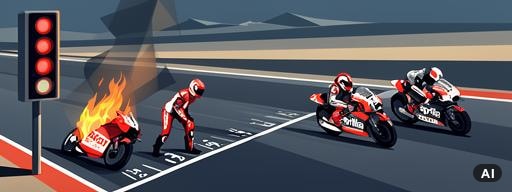
Marco Bezzecchi won the Valencia sprint from pole position, leading from start to finish ahead of Aprilia teammate Jorge Martín, with Enea Bastianini third for KTM Tech3. The outcome — Aprilia's first one-two finish in a sprint, and only Tech3's second sprint podium of the season — was overshadowed by what had happened on the grid minutes earlier.
The start lights failed to go out. Riders sat with engines running at full revs as the delay lengthened — Cadena SER put it at 25 minutes, Ilta-Sanomat at about 20 — and smoke began to come from Marc Márquez's Ducati before the machine caught fire. Márquez tried to move it clear, then abandoned it on the asphalt as the flames grew and a marshal intervened. He returned to the garage for his second bike. Stewards allowed him to retake his second-place grid slot but imposed a double long-lap penalty for leaving the formation; the decision drew boos and whistles from home fans at the Ricardo Tormo circuit, and the sprint was cut from 13 laps to 12.
Márquez finished 13th, outside the points. "Luckily, I'm OK," he told TNT Sports, suggesting the rule might be reviewed for next season. He said the sanction had been applied correctly under the regulations but argued it would have been safer to send every bike back to the pit lane while they were checked. Antena 3 reported a minor burn to his leg, which it described as of no consequence.
Ducati team manager Davide Tardozzi said the rule had been interpreted correctly but that the trouble had been caused by the organisers' failure at the lights. Riders were blunter. Jack Miller, quoted by Motorsport.com via Ilta-Sanomat, said Márquez had had no option but to hold the revs with, in his words, effectively 22 riders behind him, and that he should not have been punished. Alex Márquez said the problem lay with the lights; Iker Lecuona said the decision should have been taken within five seconds.
The weekend had already been upended. Márquez, 33, announced on Friday that Valencia would be his final grand prix, a week after sealing a record-equalling eighth premier-class title in Portugal — his tenth world championship overall, eight of them in the top class. Sunday's grand prix will be his last. Bezzecchi's victory, meanwhile, moved him one point clear of Martín in the fight for second in the championship, with Aprilia leading Ducati by 16 points in the constructors' standings.
The Divergence across 4 points of view
- Critical: EUR, SEA
- Neutral: LAT, ATL
- Favorable: no bloc
- Pale: the bloc has no reading of this story
Bloc by bloc, from the most critical to the most favourable
EUR Continental European pressCritical
Reading
The paddock speaks for the story: the champion calls the rulebook out of date, rivals call the sanction absurd, the team manager accepts the letter of the rule and rejects its sense — the grievance is theirs, not the narrator's.
Description
The fire opens a regulatory argument more than a race report: the lights froze, engines overheated, and the penalty landed on the rider rather than on the organiser. The champion, his rivals and the Ducati team manager all concede that the rule was correctly applied to the wrong party, and a rule change for next season is foreshadowed. Register swings from outrage at an unjust sanction to cool procedural explanation.
Mechanismaccusation by proxy
Criticism travels as reported speech: the rule is conceded as formally correct, then dismantled through the voices of those it hit, so the objection reads as a paddock consensus rather than an editorial line.
The outlets in this area do not agree with one another.
SEA Southeast Asian pressCritical
Reading
The regulation is read aloud and the paddock is then called as witness: rivals and the Ducati manager establish that the starting lights, not the rider, caused the fire.
Description
The question posed is procedural: why a rider whose machine caught fire was penalised at all. The rulebook is walked through — leaving the grid triggers a double long-lap penalty whatever the cause — and then the rivals' and the Ducati manager's testimony is assembled to show the fault sat in the starting system. Sympathy for the champion and the prospect of a rule change close the account.
Mechanismrulebook exegesis
Explanation comes before verdict: once the rule is spelled out step by step, the stacked testimonies read as proof that a formally correct rule produced an unjust outcome.
LAT Latin American pressNeutral
Reading
The fire holds the frame: flames, escape, extinguishers — with the sanction and the finishing position trailing behind as the tail of the same scene.
Description
The burning bike is the headline image, retold as a scene: flames on the grid, the rider pulling clear, marshals moving in. The penalty and the thirteenth place arrive inside the same chronology, and Bezzecchi's win plus Sunday's farewell close the account. The register runs from horrified exclamation to a flat question-and-answer recap.
Mechanismspectacle framing
The event is cut into scenes — ignition, escape, penalty, finish — so spectacle sets the pace and the regulatory question is carried along inside the narrative instead of being argued.
ATL Atlantic / Anglosphere pressNeutral
Reading
No side is taken: the fire, the sanction and the Aprilia one-two are laid out in sequence, and the home crowd's whistles are left to carry whatever judgement the reader wants to draw.
Description
A retiring champion's machine ignites on the grid when the start lights fail; he steps away unharmed, takes the spare bike, serves a double long-lap penalty and finishes outside the points. The sprint is then reported as a race: an Aprilia one-two, twelve laps instead of thirteen, the home crowd's whistles at the stewards. Retirement and Sunday's farewell frame the weekend without a verdict on the sanction.
Mechanismsequential report
Chronology does the arguing: cause, sanction and result are stacked in the order they happened, so the anomaly lands as a curiosity of the weekend rather than as a scandal.
This story appeared in
🇪🇸Spain2
🇮🇩Indonesia2
🇮🇹Italy2
🇦🇷Argentina1
🇦🇺Australia1
🇨🇱Chile1
🇨🇷Costa Rica1
🇫🇮Finland1
🇫🇷France1
🇬🇷Greece1
On the same topic
Broaden your view
Márquez's Ducati catches fire on Valencia grid as Bezzecchi takes sprint
The retiring world champion escaped his burning bike before the Valencia sprint, was penalised for switching machines and finished 13th, while Marco Bezzecchi led from pole.
Marco Bezzecchi won the Valencia sprint from pole position, leading from start to finish ahead of Aprilia teammate Jorge Martín, with Enea Bastianini third for KTM Tech3. The outcome — Aprilia's first one-two finish in a sprint, and only Tech3's second sprint podium of the season — was overshadowed by what had happened on the grid minutes earlier.
The start lights failed to go out. Riders sat with engines running at full revs as the delay lengthened — Cadena SER put it at 25 minutes, Ilta-Sanomat at about 20 — and smoke began to come from Marc Márquez's Ducati before the machine caught fire. Márquez tried to move it clear, then abandoned it on the asphalt as the flames grew and a marshal intervened. He returned to the garage for his second bike. Stewards allowed him to retake his second-place grid slot but imposed a double long-lap penalty for leaving the formation; the decision drew boos and whistles from home fans at the Ricardo Tormo circuit, and the sprint was cut from 13 laps to 12.
Márquez finished 13th, outside the points. "Luckily, I'm OK," he told TNT Sports, suggesting the rule might be reviewed for next season. He said the sanction had been applied correctly under the regulations but argued it would have been safer to send every bike back to the pit lane while they were checked. Antena 3 reported a minor burn to his leg, which it described as of no consequence.
Ducati team manager Davide Tardozzi said the rule had been interpreted correctly but that the trouble had been caused by the organisers' failure at the lights. Riders were blunter. Jack Miller, quoted by Motorsport.com via Ilta-Sanomat, said Márquez had had no option but to hold the revs with, in his words, effectively 22 riders behind him, and that he should not have been punished. Alex Márquez said the problem lay with the lights; Iker Lecuona said the decision should have been taken within five seconds.
The weekend had already been upended. Márquez, 33, announced on Friday that Valencia would be his final grand prix, a week after sealing a record-equalling eighth premier-class title in Portugal — his tenth world championship overall, eight of them in the top class. Sunday's grand prix will be his last. Bezzecchi's victory, meanwhile, moved him one point clear of Martín in the fight for second in the championship, with Aprilia leading Ducati by 16 points in the constructors' standings.
The Divergence across 4 points of view
- Critical: EUR, SEA
- Neutral: LAT, ATL
- Favorable: no bloc
- Pale: the bloc has no reading of this story
EUR Continental European pressCritical
Reading
The paddock speaks for the story: the champion calls the rulebook out of date, rivals call the sanction absurd, the team manager accepts the letter of the rule and rejects its sense — the grievance is theirs, not the narrator's.
Description
The fire opens a regulatory argument more than a race report: the lights froze, engines overheated, and the penalty landed on the rider rather than on the organiser. The champion, his rivals and the Ducati team manager all concede that the rule was correctly applied to the wrong party, and a rule change for next season is foreshadowed. Register swings from outrage at an unjust sanction to cool procedural explanation.
Mechanismaccusation by proxy
Criticism travels as reported speech: the rule is conceded as formally correct, then dismantled through the voices of those it hit, so the objection reads as a paddock consensus rather than an editorial line.
The outlets in this area do not agree with one another.
Bloc by bloc, from the most critical to the most favourable
EUR Continental European pressCritical
Reading
The paddock speaks for the story: the champion calls the rulebook out of date, rivals call the sanction absurd, the team manager accepts the letter of the rule and rejects its sense — the grievance is theirs, not the narrator's.
Description
The fire opens a regulatory argument more than a race report: the lights froze, engines overheated, and the penalty landed on the rider rather than on the organiser. The champion, his rivals and the Ducati team manager all concede that the rule was correctly applied to the wrong party, and a rule change for next season is foreshadowed. Register swings from outrage at an unjust sanction to cool procedural explanation.
Mechanismaccusation by proxy
Criticism travels as reported speech: the rule is conceded as formally correct, then dismantled through the voices of those it hit, so the objection reads as a paddock consensus rather than an editorial line.
The outlets in this area do not agree with one another.
SEA Southeast Asian pressCritical
Reading
The regulation is read aloud and the paddock is then called as witness: rivals and the Ducati manager establish that the starting lights, not the rider, caused the fire.
Description
The question posed is procedural: why a rider whose machine caught fire was penalised at all. The rulebook is walked through — leaving the grid triggers a double long-lap penalty whatever the cause — and then the rivals' and the Ducati manager's testimony is assembled to show the fault sat in the starting system. Sympathy for the champion and the prospect of a rule change close the account.
Mechanismrulebook exegesis
Explanation comes before verdict: once the rule is spelled out step by step, the stacked testimonies read as proof that a formally correct rule produced an unjust outcome.
LAT Latin American pressNeutral
Reading
The fire holds the frame: flames, escape, extinguishers — with the sanction and the finishing position trailing behind as the tail of the same scene.
Description
The burning bike is the headline image, retold as a scene: flames on the grid, the rider pulling clear, marshals moving in. The penalty and the thirteenth place arrive inside the same chronology, and Bezzecchi's win plus Sunday's farewell close the account. The register runs from horrified exclamation to a flat question-and-answer recap.
Mechanismspectacle framing
The event is cut into scenes — ignition, escape, penalty, finish — so spectacle sets the pace and the regulatory question is carried along inside the narrative instead of being argued.
ATL Atlantic / Anglosphere pressNeutral
Reading
No side is taken: the fire, the sanction and the Aprilia one-two are laid out in sequence, and the home crowd's whistles are left to carry whatever judgement the reader wants to draw.
Description
A retiring champion's machine ignites on the grid when the start lights fail; he steps away unharmed, takes the spare bike, serves a double long-lap penalty and finishes outside the points. The sprint is then reported as a race: an Aprilia one-two, twelve laps instead of thirteen, the home crowd's whistles at the stewards. Retirement and Sunday's farewell frame the weekend without a verdict on the sanction.
Mechanismsequential report
Chronology does the arguing: cause, sanction and result are stacked in the order they happened, so the anomaly lands as a curiosity of the weekend rather than as a scandal.