Greek crews recover two bodies off Gavdos amid 1,200 migrant arrivals
Survivors were taken to Crete for treatment after a two-day surge in which the coast guard and Frontex picked up more than 1,200 people, with no nationalities yet released.
How they tell it
15%25 outlets · 12 languages
1 critical, 11 neutral, none favorable
PALESTINESECritical
Crete's reception collapse is the centre of gravity; Athens' deterrence and Europe's externalisation plans are judged against the people left outdoors.
RUS Russian & CIS pressNeutral
Greek authorities narrate the rescue sequence and the pressure on Crete; the item stays with official counts and operational promises.
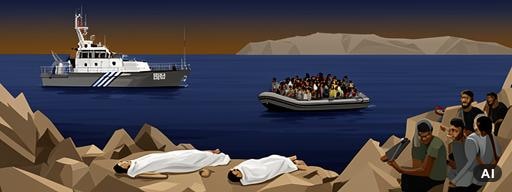
Greece's coast guard recovered two bodies and rescued 41 people on the island of Gavdos on Saturday, in operations that also brought more than 1,200 people ashore near Crete and Gavdos over two days, according to coast guard figures reported by The Independent and NRC. Four of the survivors found on a rocky stretch of Gavdos were taken to Crete for medical treatment. The count is not uniform across outlets: Index.hr and HotNews, both citing the Associated Press, put the two-day total at more than 1,100, while N1 Srbija reports more than 1,100 arrivals, attributing the figure to the authorities and the coast guard. No nationalities were released, although all those involved were believed to have set sail from Libya.
Further details emerged piecemeal. Index.hr, 15min and O Globo report that 102 migrants, among them 16 women and five minors, were taken to the port of Heraklion, and that a further six operations near Gavdos and Crete rescued 391 people. As darkness fell on Saturday the coast guard was still reporting new arrivals, with three boats carrying a total of more than 150 people found south of Crete, according to The Independent and NRC. Reuters-sourced accounts in Agência Brasil, The News International and O Globo describe about 1,000 people taken from boats off Crete in more than a dozen separate operations. The cause of the two deaths has not been officially established; The Independent, citing local media, reported that the boat appeared to have struck rocks on arrival.
For Athens, the pressure falls on a southern route that has grown in recent years. Index.hr reports more than 23,000 arrivals on Crete and nearby islands from the start of the year to early November, straining local reception centres. The International Organization for Migration has warned, according to Index.hr, 15min and O Globo, that the increase exposes shortcomings in search-and-rescue capacity. Earlier this month the bodies of 22 people were found in two boats sailing from Libya towards southern Greece, a figure carried by The Independent, Südtirol News, N1 Srbija and HotNews; NOS reported twenty. The crossing from Libya has become one of the most frequently used routes into Europe, The Independent notes, and Agência Brasil and The News International report that arrivals on it in recent years have come mostly from Bangladesh and from people fleeing violence in Sudan.
Policy has tightened rather than opened. Greece is one of five EU states — with Austria, Denmark, Germany and the Netherlands — aiming to establish a "return hub" in Rwanda for rejected asylum seekers from next year, a plan that Südtirol News says should see its first centre open in 2027. The Independent, Index.hr and N1 Srbija report that human rights groups have criticised the plan, and NOS reports that France and Spain have raised concerns. Agência Brasil and The News International report that Greece has stepped up repatriation of rejected asylum seekers this year. The coast guard had not identified the nationalities or the exact departure point of those rescued as of Saturday evening, and continued to log arrivals.
The Divergence across 12 points of view
- Critical: PALESTINESE
- Neutral: LAT, AFR, ATL, EUR, GIAPPONE_COREA_TAIWAN, ALM, IND, RUS, CIN, TUR, SEA
- Favorable: no bloc
- Pale: the bloc has no reading of this story
Bloc by bloc, from the most critical to the most favourable
PALESTINESECritical
Reading
Crete's reception collapse is the centre of gravity; Athens' deterrence and Europe's externalisation plans are judged against the people left outdoors.
Description
The surge is narrated as a humanitarian pressure crisis: about 2,500 people on Crete, hundreds sleeping outdoors and reception facilities at their limit. It links the emergency to European far-right gains and deportation plans, including the Rwanda hub.
Mechanismhumanitarian pressure frame
Overcrowding is described through concrete scenes, then tied to the political turn toward deterrence and deportation.
LAT Latin American pressNeutral
Reading
The rescue effort and the dead are kept at the centre, while European deterrence and deportation plans are weighed against the route's danger.
Description
The coverage stresses rescue operations and risk: two dead on Gavdos, hundreds saved near Crete and reception sites over capacity. It adds IOM concern about search-and-rescue gaps and criticism of the Rwanda return-hub plan.
Mechanismrescue-and-risk frame
Concrete rescue details and IOM warnings are combined to make the policy debate a question of protection capacity.
AFR Sub-Saharan African pressNeutral
Reading
The pressure on Cretan reception is the lead; Athens' hard line and Europe's return-hub plan are presented as the political backdrop to overcrowding.
Description
Crete is described as overwhelmed: about 2,500 migrants on the island, hundreds outdoors at Heraklion and a promised ship for transfers. The item ties the surge to Libyan departures, far-right gains and the Rwanda deportation hub.
Mechanismoverload-and-deterrence frame
Reception overload is shown through concrete scenes, then linked to the wider shift toward deterrence and deportation.
ATL Atlantic / Anglosphere pressNeutral
Reading
Athens' deterrence strategy is measured against overcrowded landing points and deaths at sea, while the EU externalisation plan is left exposed to rights scrutiny.
Description
The Crete surge is treated as a test of Greece's hard-line migration policy: rescue figures and two deaths sit beside the EU return-hub plan and rights criticism. The dangerous Libya route is stressed, along with the gap between deterrence and reception capacity.
Mechanismpolicy-test framing
Rescue counts are set beside policy deterrents, so the contradiction emerges through juxtaposition rather than argument.
EUR Continental European pressNeutral
Reading
A seasonal rush before winter turns Crete and Gavdos into the pressure point of the Mediterranean route; rescue capacity, reception space and return policy are placed on the same ledger.
Description
The weekend is framed as an operational emergency: Greek and Frontex teams pull more than a thousand people from boats near Crete and Gavdos while reception sites overflow. Weather, Libyan departures and EU return plans are folded into a broader warning about the route's danger.
Mechanismoperational escalation
Seasonal weather and rescue logistics are used to scale the event from a local landing to a European border emergency.
GIAPPONE_COREA_TAIWANNeutral
Reading
The human cost of the crossing is kept in view while Athens' deterrence policy and the EU return-hub plan are placed under scrutiny.
Description
The piece balances rescue numbers and two deaths with the government's hard line and the criticised Rwanda return-hub plan. It places the Libya-to-Crete crossing among the most used and most deadly routes into Europe.
Mechanismhumanitarian-wire balance
Death toll and policy criticism are paired, so the rescue story also becomes a test of deterrence.
ALM Arab Levant-Maghreb pressNeutral
Reading
North African departures and Greek deterrence are held together; the Rwanda plan is reported with the rights criticism attached.
Description
The arrival of more than 1,100 people from North Africa is set against Athens' tough migration stance and the plan for a Rwanda return hub. It notes two deaths, rescued survivors and criticism from rights groups.
Mechanismroute-and-rights frame
The route is traced from Libya to Crete while the return-hub plan is placed in the same paragraph as its critics.
IND Indian & South Asian pressNeutral
Reading
The coast guard's rescue account leads, while Europe's political turn and the Rwanda plan are appended as background.
Description
Two wire reports trace the rescue of 41 people and recovery of two bodies on Gavdos, alongside about 1,000 taken from boats off Crete. They add the Libya route, the far-right surge and the Rwanda deportation plan as context.
Mechanismgateway-crisis frame
The immediate rescue is followed by a standard contextual paragraph on routes and far-right politics.
RUS Russian & CIS pressNeutral
Reading
Greek authorities narrate the rescue sequence and the pressure on Crete; the item stays with official counts and operational promises.
Description
The account is a compact wire-style chronology: 1,700 rescued or arrived near Crete, two bodies on Gavdos, 2,500 people on the island and a ship promised for transfers. It avoids policy judgement and keeps to official statements.
Mechanismwire chronology
Official statements and rescue numbers are arranged in sequence, leaving the policy debate outside the frame.
CIN Chinese pressNeutral
Reading
The coast guard's rescue tally carries the story; Crete's reception strain appears only as a background fact.
Description
A short dispatch records the 'most difficult' 48 hours, 1,000 rescued off Crete and 190 more on Sunday. It keeps to agency figures and does not develop the EU policy dispute.
Mechanismbrief wire distillation
The item compresses the event into a few agency figures and a minister's phrase.
TUR Turkish pressNeutral
Reading
The migration minister's record-arrival statement anchors the item; the broader EU policy debate stays outside the main line.
Description
The story is built around a record daily count: at least 2,027 arrivals on Crete in 24 hours and more than 25,000 this year. It adds that hundreds more may be approaching as bad weather hits Greece.
Mechanismrecord-count emphasis
The highest daily total is placed at the top and repeated through annual figures.
SEA Southeast Asian pressNeutral
Reading
Athens' official language and coast guard figures carry a straightforward account of rescue, overload and promised transfers.
Description
The Reuters recap presents the 48-hour surge as the year's most difficult, with 1,000 rescued and 700 reaching Crete. It includes the two deaths on Gavdos, reception overload and the EU return-hub plan.
Mechanismneutral wire recap
The sequence moves from rescue to reception to policy context without commentary.
This story appeared in
🇧🇷Brazil3
🇦🇹Austria1
🇧🇪Belgium1
🇧🇬Bulgaria1
🇧🇾Belarus1
🇨🇾Cyprus1
🇩🇪Germany1
🇫🇮Finland1
🇫🇷France1
🇬🇧United Kingdom1
Show all 25 outlets
🇭🇰Hong Kong SAR China1
🇭🇷Croatia1
🇰🇷South Korea1
🇱🇧Lebanon1
🇱🇹Lithuania1
🇲🇾Malaysia1
🇳🇱Netherlands1
🇵🇰Pakistan1
🇵🇸Palestinian Territories1
🇷🇴Romania1
🇸🇬Singapore1
🇹🇷Türkiye1
🇿🇦South Africa1
On the same topic
Broaden your view
Greek crews recover two bodies off Gavdos amid 1,200 migrant arrivals
Survivors were taken to Crete for treatment after a two-day surge in which the coast guard and Frontex picked up more than 1,200 people, with no nationalities yet released.
Greece's coast guard recovered two bodies and rescued 41 people on the island of Gavdos on Saturday, in operations that also brought more than 1,200 people ashore near Crete and Gavdos over two days, according to coast guard figures reported by The Independent and NRC. Four of the survivors found on a rocky stretch of Gavdos were taken to Crete for medical treatment. The count is not uniform across outlets: Index.hr and HotNews, both citing the Associated Press, put the two-day total at more than 1,100, while N1 Srbija reports more than 1,100 arrivals, attributing the figure to the authorities and the coast guard. No nationalities were released, although all those involved were believed to have set sail from Libya.
Further details emerged piecemeal. Index.hr, 15min and O Globo report that 102 migrants, among them 16 women and five minors, were taken to the port of Heraklion, and that a further six operations near Gavdos and Crete rescued 391 people. As darkness fell on Saturday the coast guard was still reporting new arrivals, with three boats carrying a total of more than 150 people found south of Crete, according to The Independent and NRC. Reuters-sourced accounts in Agência Brasil, The News International and O Globo describe about 1,000 people taken from boats off Crete in more than a dozen separate operations. The cause of the two deaths has not been officially established; The Independent, citing local media, reported that the boat appeared to have struck rocks on arrival.
For Athens, the pressure falls on a southern route that has grown in recent years. Index.hr reports more than 23,000 arrivals on Crete and nearby islands from the start of the year to early November, straining local reception centres. The International Organization for Migration has warned, according to Index.hr, 15min and O Globo, that the increase exposes shortcomings in search-and-rescue capacity. Earlier this month the bodies of 22 people were found in two boats sailing from Libya towards southern Greece, a figure carried by The Independent, Südtirol News, N1 Srbija and HotNews; NOS reported twenty. The crossing from Libya has become one of the most frequently used routes into Europe, The Independent notes, and Agência Brasil and The News International report that arrivals on it in recent years have come mostly from Bangladesh and from people fleeing violence in Sudan.
Policy has tightened rather than opened. Greece is one of five EU states — with Austria, Denmark, Germany and the Netherlands — aiming to establish a "return hub" in Rwanda for rejected asylum seekers from next year, a plan that Südtirol News says should see its first centre open in 2027. The Independent, Index.hr and N1 Srbija report that human rights groups have criticised the plan, and NOS reports that France and Spain have raised concerns. Agência Brasil and The News International report that Greece has stepped up repatriation of rejected asylum seekers this year. The coast guard had not identified the nationalities or the exact departure point of those rescued as of Saturday evening, and continued to log arrivals.
The Divergence across 12 points of view
- Critical: PALESTINESE
- Neutral: LAT, AFR, ATL, EUR, GIAPPONE_COREA_TAIWAN, ALM, IND, RUS, CIN, TUR, SEA
- Favorable: no bloc
- Pale: the bloc has no reading of this story
PALESTINESECritical
Reading
Crete's reception collapse is the centre of gravity; Athens' deterrence and Europe's externalisation plans are judged against the people left outdoors.
Description
The surge is narrated as a humanitarian pressure crisis: about 2,500 people on Crete, hundreds sleeping outdoors and reception facilities at their limit. It links the emergency to European far-right gains and deportation plans, including the Rwanda hub.
Mechanismhumanitarian pressure frame
Overcrowding is described through concrete scenes, then tied to the political turn toward deterrence and deportation.
Bloc by bloc, from the most critical to the most favourable
PALESTINESECritical
Reading
Crete's reception collapse is the centre of gravity; Athens' deterrence and Europe's externalisation plans are judged against the people left outdoors.
Description
The surge is narrated as a humanitarian pressure crisis: about 2,500 people on Crete, hundreds sleeping outdoors and reception facilities at their limit. It links the emergency to European far-right gains and deportation plans, including the Rwanda hub.
Mechanismhumanitarian pressure frame
Overcrowding is described through concrete scenes, then tied to the political turn toward deterrence and deportation.
LAT Latin American pressNeutral
Reading
The rescue effort and the dead are kept at the centre, while European deterrence and deportation plans are weighed against the route's danger.
Description
The coverage stresses rescue operations and risk: two dead on Gavdos, hundreds saved near Crete and reception sites over capacity. It adds IOM concern about search-and-rescue gaps and criticism of the Rwanda return-hub plan.
Mechanismrescue-and-risk frame
Concrete rescue details and IOM warnings are combined to make the policy debate a question of protection capacity.
AFR Sub-Saharan African pressNeutral
Reading
The pressure on Cretan reception is the lead; Athens' hard line and Europe's return-hub plan are presented as the political backdrop to overcrowding.
Description
Crete is described as overwhelmed: about 2,500 migrants on the island, hundreds outdoors at Heraklion and a promised ship for transfers. The item ties the surge to Libyan departures, far-right gains and the Rwanda deportation hub.
Mechanismoverload-and-deterrence frame
Reception overload is shown through concrete scenes, then linked to the wider shift toward deterrence and deportation.
ATL Atlantic / Anglosphere pressNeutral
Reading
Athens' deterrence strategy is measured against overcrowded landing points and deaths at sea, while the EU externalisation plan is left exposed to rights scrutiny.
Description
The Crete surge is treated as a test of Greece's hard-line migration policy: rescue figures and two deaths sit beside the EU return-hub plan and rights criticism. The dangerous Libya route is stressed, along with the gap between deterrence and reception capacity.
Mechanismpolicy-test framing
Rescue counts are set beside policy deterrents, so the contradiction emerges through juxtaposition rather than argument.
EUR Continental European pressNeutral
Reading
A seasonal rush before winter turns Crete and Gavdos into the pressure point of the Mediterranean route; rescue capacity, reception space and return policy are placed on the same ledger.
Description
The weekend is framed as an operational emergency: Greek and Frontex teams pull more than a thousand people from boats near Crete and Gavdos while reception sites overflow. Weather, Libyan departures and EU return plans are folded into a broader warning about the route's danger.
Mechanismoperational escalation
Seasonal weather and rescue logistics are used to scale the event from a local landing to a European border emergency.
GIAPPONE_COREA_TAIWANNeutral
Reading
The human cost of the crossing is kept in view while Athens' deterrence policy and the EU return-hub plan are placed under scrutiny.
Description
The piece balances rescue numbers and two deaths with the government's hard line and the criticised Rwanda return-hub plan. It places the Libya-to-Crete crossing among the most used and most deadly routes into Europe.
Mechanismhumanitarian-wire balance
Death toll and policy criticism are paired, so the rescue story also becomes a test of deterrence.
ALM Arab Levant-Maghreb pressNeutral
Reading
North African departures and Greek deterrence are held together; the Rwanda plan is reported with the rights criticism attached.
Description
The arrival of more than 1,100 people from North Africa is set against Athens' tough migration stance and the plan for a Rwanda return hub. It notes two deaths, rescued survivors and criticism from rights groups.
Mechanismroute-and-rights frame
The route is traced from Libya to Crete while the return-hub plan is placed in the same paragraph as its critics.
IND Indian & South Asian pressNeutral
Reading
The coast guard's rescue account leads, while Europe's political turn and the Rwanda plan are appended as background.
Description
Two wire reports trace the rescue of 41 people and recovery of two bodies on Gavdos, alongside about 1,000 taken from boats off Crete. They add the Libya route, the far-right surge and the Rwanda deportation plan as context.
Mechanismgateway-crisis frame
The immediate rescue is followed by a standard contextual paragraph on routes and far-right politics.
RUS Russian & CIS pressNeutral
Reading
Greek authorities narrate the rescue sequence and the pressure on Crete; the item stays with official counts and operational promises.
Description
The account is a compact wire-style chronology: 1,700 rescued or arrived near Crete, two bodies on Gavdos, 2,500 people on the island and a ship promised for transfers. It avoids policy judgement and keeps to official statements.
Mechanismwire chronology
Official statements and rescue numbers are arranged in sequence, leaving the policy debate outside the frame.
CIN Chinese pressNeutral
Reading
The coast guard's rescue tally carries the story; Crete's reception strain appears only as a background fact.
Description
A short dispatch records the 'most difficult' 48 hours, 1,000 rescued off Crete and 190 more on Sunday. It keeps to agency figures and does not develop the EU policy dispute.
Mechanismbrief wire distillation
The item compresses the event into a few agency figures and a minister's phrase.
TUR Turkish pressNeutral
Reading
The migration minister's record-arrival statement anchors the item; the broader EU policy debate stays outside the main line.
Description
The story is built around a record daily count: at least 2,027 arrivals on Crete in 24 hours and more than 25,000 this year. It adds that hundreds more may be approaching as bad weather hits Greece.
Mechanismrecord-count emphasis
The highest daily total is placed at the top and repeated through annual figures.
SEA Southeast Asian pressNeutral
Reading
Athens' official language and coast guard figures carry a straightforward account of rescue, overload and promised transfers.
Description
The Reuters recap presents the 48-hour surge as the year's most difficult, with 1,000 rescued and 700 reaching Crete. It includes the two deaths on Gavdos, reception overload and the EU return-hub plan.
Mechanismneutral wire recap
The sequence moves from rescue to reception to policy context without commentary.