Trump endorses Baghdad's federal control of Kurdish oil and border crossings
The US president's Truth Social statement follows Baghdad's designation of crude exports outside the state marketer as smuggling, as Erbil rejects federal moves and protesters take to the streets.
How they tell it
9%13 outlets · 4 languages
none critical, 7 neutral, none favorable
Read the divergences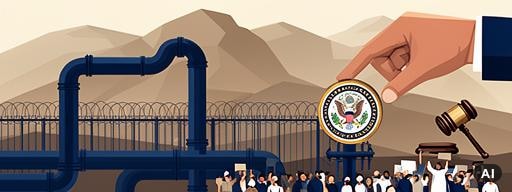
President Donald Trump on Friday backed Prime Minister Ali al-Zaidi's drive to assert state control over Iraq's oil and armed groups, saying in a Truth Social post that Washington supports efforts "to assert state authority throughout Iraq, stop the smuggling of Iraqi oil, end corruption, and bring all weapons under the exclusive control of the state." The statement appeared shortly after government spokesman Haider al-Aboudi said Baghdad considered crude exports that bypass the state marketer SOMO to be smuggling, because the proceeds do not reach the treasury.
Speaking to the state news agency, Mr Aboudi estimated Iraq's losses to smuggling through the Kurdistan region at $100 billion between 2008 and 2025; the reporting did not explain how the figure was calculated. Oil Minister Basim Mohammed told a news conference that "the oilfields in the region and Basra belong to all Iraqis and remain under the Iraqi flag." In Erbil, the Kurdistan Regional Government rejected what it called the "military language and threats" in the army spokesman's announcement, called the measures a constitutional violation and said it was working with federal authorities to combat corruption. Iraq closed two crossings in the region, one with Syria and one with Iran, on Thursday, and thousands of Kurds protested against the deployment of federal troops and the transfer of oilfields to federal control.
Iraq's highest court ruled on Wednesday that Baghdad may deploy federal forces along all international borders, including those of the Kurdistan region — a decision that appeared to favour Mr Zaidi, a 41-year-old businessman and political novice who came to power in a compromise six months ago. A week earlier he ordered the army to move on Jurf al-Sakhar, south of Baghdad, where the government accuses the Iran-aligned militia Kataib Hezbollah of running a smuggling operation; the group was initially defiant but agreed to let soldiers enter. The state news agency cited an intelligence document, seen but not independently authenticated by AFP, showing crude moved by tanker truck from Kirkuk and Sulaymaniyah into Iran, blended with Iranian crude and exported to Afghanistan.
Reporting by AFP puts oil exports at 90 per cent of Iraqi revenues, and notes that the Middle East war and disruption of the Strait of Hormuz have hit them; the United States has also slowed cash shipments for Iraqi oil sales handled by the Federal Reserve Bank of New York. Mr Zaidi has cultivated ties with Trump envoy Tom Barrack, who is promoting US oil investment and an export route through Syria. The last remaining US troops left Iraq at the end of September, while RFI reports US forces completed their withdrawal from Iraqi Kurdistan in October; the pullout was meant to run in parallel with the disarmament of Iran-backed militias, before the deadline was extended to June 2027. Trump has said he was responsible for Mr Zaidi's rise to the premiership and hosted him at the White House in July.
Analysts in the AFP-syndicated reporting describe the measures as difficult to implement against entrenched interests. Lawk Ghafuri, an Erbil-based analyst, said the Kurds would treat the decision as a threat but would eventually strike a deal, and that Mr Zaidi's method is to raise the stakes far enough to secure concessions. Iraqi political sources told AFP that ties with Tehran have been strained and that Iran will not accept the disarmament of allied factions during a regional war. Iraqi authorities said on Thursday that an agreement had been reached on a national dialogue over the constitutional tension, and the judiciary chief, Faeq Zaidan, widely seen as close to Mr Zaidi, called for talks next week. The government has not specified when or how federal control would be implemented.
The Divergence across 7 points of view
- Critical: no bloc
- Neutral: EUR, IND, AFR, ISR, LAT, SEA, GLF
- Favorable: no bloc
- Pale: the bloc has no reading of this story
Bloc by bloc, from the most critical to the most favourable
EUR Continental European pressNeutral
Reading
Kurdish autonomy and Iranian leverage carry the account: the crackdown is a strategic risk as much as an anti-corruption drive, and Baghdad's victory is conditional.
Description
Trump's endorsement of Baghdad's state-building and anti-smuggling drive is read through its regional costs: Kurdish autonomy is pressured and Iran may gain from the confrontation. The oil dispute is placed in the long contest over Kurdistan's fields, borders and budget, with US pressure on Iran and Washington's ties to Zaidi shaping the wider frame. The story appears less a clear victory than a risky reordering of power in northern Iraq.
Mechanismstrategic contextualization
It widens the lens to the 2005 constitution, the 2017 Kirkuk precedent and US-Iran competition, making the local move legible as a regional power shift.
IND Indian & South Asian pressNeutral
Reading
Analysts and officials speak: Zaidi's campaign is a US-aligned bet on central authority, with Kurdish and Iranian backlash treated as a calculated risk.
Description
The crackdown is explained through US interests: a stronger central government in Baghdad can curb Iran-backed groups and secure oil, even if it weakens Kurdish autonomy. Analysts and officials describe Zaidi as steering toward Washington, with Tom Barrack and US oil-investment ambitions shaping the stakes. The move is a high-risk bet that may strain ties with Erbil and Tehran while promising financial relief.
Mechanisminterest-based analysis
It connects the oil crackdown to US sanctions policy, investment routes and budget pressure, making the strategy legible as interest-driven rather than merely legal.
AFR Sub-Saharan African pressNeutral
Reading
Washington and Baghdad speak first: the crackdown is framed as restoring state authority and stopping oil smuggling, with Kurdish objections and the disputed loss figure left as counterpoints.
Description
Trump endorses Prime Minister Ali al-Zaidi's drive to extend state authority, curb oil smuggling and bring all weapons under state control. The push sets Baghdad against Iran-aligned militias and Kurdish authorities, with Iraq claiming $100bn in smuggling losses through Kurdistan and Kurds protesting federal control. A court ruling and a standoff with Kataib Hezbollah frame the crackdown as a test of state power.
Mechanismattribution with caveat
Claims are attributed to named officials, and the $100bn estimate is immediately marked as unexplained, producing a balanced but official-led account.
ISR Israeli pressNeutral
Reading
Official statements and the court ruling carry the account, with the Kurdish rejection and armed-group standoffs framed as security tests for Baghdad.
Description
Trump backs Zaidi's assertion of state authority, anti-smuggling measures and weapons control, setting Baghdad against Iran-aligned militias and Kurdish authorities. The report notes Iraq's $100bn smuggling estimate, Kurdish protests, a court ruling allowing federal border deployment and a standoff with Kataib Hezbollah. The confrontation is presented as a test of whether a novice prime minister can challenge entrenched armed interests.
Mechanismsecurity attribution
It anchors the story in named claims and legal authorization, then lists the opposing factions, keeping the tone factual while emphasizing confrontation.
LAT Latin American pressNeutral
Reading
Baghdad's campaign is the active subject: it moves to recover oil control, while Kurdish rejection and militia denial appear as reactions.
Description
Trump backs Iraq's campaign to regain state control over oil, fight smuggling and reduce corruption. The plan tightens federal control over Kurdistan's border crossings and oilfields, prompting Kurdish protests and accusations of centralization, while Kataib Hezbollah denies involvement in smuggling. The story is framed as a confrontation between state authority and entrenched regional and militia interests.
Mechanismofficial action framing
It organizes the account around the government's planned measures and then adds Kurdish and Kataib Hezbollah responses, making the action seem coherent and state-led.
SEA Southeast Asian pressNeutral
Reading
Washington and Baghdad set the terms: anti-smuggling is the stated aim, with Kurdish rejection and an unauthenticated intelligence document as the main counterpoints.
Description
Trump supports Zaidi's anti-smuggling and anti-corruption drive, which has included arrests and a challenge to an Iran-backed armed group. Kurdish authorities call the federal takeover a constitutional violation, while an intelligence document cited by state media describes crude being moved into Iran and blended to evade sanctions. The account stays close to official claims and the legal dispute.
Mechanismdocument attribution
It leans on a cited intelligence document and official statements, noting that the document could not be independently authenticated, which keeps the frame factual but official-led.
GLF Arab Gulf pressNeutral
Reading
Washington's endorsement and Baghdad's anti-smuggling rationale carry the account, with Kurdish objections recorded as a constitutional dispute rather than a competing moral claim.
Description
Trump's support for Al-Zaidi is presented as backing a practical anti-smuggling and anti-corruption campaign. The emphasis falls on federal control of Kurdistan's crossings and oilfields, Iran's sanctions evasion and Baghdad's claimed $100bn in losses, with Kurdish denunciation and a call for dialogue noted. The crackdown is framed as a test of state authority and a move to secure oil revenue.
Mechanismofficial endorsement framing
It selects the presidential quote and the official loss estimate as the spine, then adds Kurdish rejection and a call for dialogue as procedural caveats.
This story appeared in
🇮🇳India2
🇦🇪United Arab Emirates1
🇧🇩Bangladesh1
🇨🇭Switzerland1
🇨🇾Cyprus1
🇪🇨Ecuador1
🇫🇷France1
🇮🇱Israel1
🇲🇽Mexico1
🇲🇾Malaysia1
On the same topic
Broaden your view
Trump endorses Baghdad's federal control of Kurdish oil and border crossings
The US president's Truth Social statement follows Baghdad's designation of crude exports outside the state marketer as smuggling, as Erbil rejects federal moves and protesters take to the streets.
President Donald Trump on Friday backed Prime Minister Ali al-Zaidi's drive to assert state control over Iraq's oil and armed groups, saying in a Truth Social post that Washington supports efforts "to assert state authority throughout Iraq, stop the smuggling of Iraqi oil, end corruption, and bring all weapons under the exclusive control of the state." The statement appeared shortly after government spokesman Haider al-Aboudi said Baghdad considered crude exports that bypass the state marketer SOMO to be smuggling, because the proceeds do not reach the treasury.
Speaking to the state news agency, Mr Aboudi estimated Iraq's losses to smuggling through the Kurdistan region at $100 billion between 2008 and 2025; the reporting did not explain how the figure was calculated. Oil Minister Basim Mohammed told a news conference that "the oilfields in the region and Basra belong to all Iraqis and remain under the Iraqi flag." In Erbil, the Kurdistan Regional Government rejected what it called the "military language and threats" in the army spokesman's announcement, called the measures a constitutional violation and said it was working with federal authorities to combat corruption. Iraq closed two crossings in the region, one with Syria and one with Iran, on Thursday, and thousands of Kurds protested against the deployment of federal troops and the transfer of oilfields to federal control.
Iraq's highest court ruled on Wednesday that Baghdad may deploy federal forces along all international borders, including those of the Kurdistan region — a decision that appeared to favour Mr Zaidi, a 41-year-old businessman and political novice who came to power in a compromise six months ago. A week earlier he ordered the army to move on Jurf al-Sakhar, south of Baghdad, where the government accuses the Iran-aligned militia Kataib Hezbollah of running a smuggling operation; the group was initially defiant but agreed to let soldiers enter. The state news agency cited an intelligence document, seen but not independently authenticated by AFP, showing crude moved by tanker truck from Kirkuk and Sulaymaniyah into Iran, blended with Iranian crude and exported to Afghanistan.
Reporting by AFP puts oil exports at 90 per cent of Iraqi revenues, and notes that the Middle East war and disruption of the Strait of Hormuz have hit them; the United States has also slowed cash shipments for Iraqi oil sales handled by the Federal Reserve Bank of New York. Mr Zaidi has cultivated ties with Trump envoy Tom Barrack, who is promoting US oil investment and an export route through Syria. The last remaining US troops left Iraq at the end of September, while RFI reports US forces completed their withdrawal from Iraqi Kurdistan in October; the pullout was meant to run in parallel with the disarmament of Iran-backed militias, before the deadline was extended to June 2027. Trump has said he was responsible for Mr Zaidi's rise to the premiership and hosted him at the White House in July.
Analysts in the AFP-syndicated reporting describe the measures as difficult to implement against entrenched interests. Lawk Ghafuri, an Erbil-based analyst, said the Kurds would treat the decision as a threat but would eventually strike a deal, and that Mr Zaidi's method is to raise the stakes far enough to secure concessions. Iraqi political sources told AFP that ties with Tehran have been strained and that Iran will not accept the disarmament of allied factions during a regional war. Iraqi authorities said on Thursday that an agreement had been reached on a national dialogue over the constitutional tension, and the judiciary chief, Faeq Zaidan, widely seen as close to Mr Zaidi, called for talks next week. The government has not specified when or how federal control would be implemented.
The Divergence across 7 points of view
- Critical: no bloc
- Neutral: EUR, IND, AFR, ISR, LAT, SEA, GLF
- Favorable: no bloc
- Pale: the bloc has no reading of this story
EUR Continental European pressNeutral
Reading
Kurdish autonomy and Iranian leverage carry the account: the crackdown is a strategic risk as much as an anti-corruption drive, and Baghdad's victory is conditional.
Description
Trump's endorsement of Baghdad's state-building and anti-smuggling drive is read through its regional costs: Kurdish autonomy is pressured and Iran may gain from the confrontation. The oil dispute is placed in the long contest over Kurdistan's fields, borders and budget, with US pressure on Iran and Washington's ties to Zaidi shaping the wider frame. The story appears less a clear victory than a risky reordering of power in northern Iraq.
Mechanismstrategic contextualization
It widens the lens to the 2005 constitution, the 2017 Kirkuk precedent and US-Iran competition, making the local move legible as a regional power shift.
Bloc by bloc, from the most critical to the most favourable
EUR Continental European pressNeutral
Reading
Kurdish autonomy and Iranian leverage carry the account: the crackdown is a strategic risk as much as an anti-corruption drive, and Baghdad's victory is conditional.
Description
Trump's endorsement of Baghdad's state-building and anti-smuggling drive is read through its regional costs: Kurdish autonomy is pressured and Iran may gain from the confrontation. The oil dispute is placed in the long contest over Kurdistan's fields, borders and budget, with US pressure on Iran and Washington's ties to Zaidi shaping the wider frame. The story appears less a clear victory than a risky reordering of power in northern Iraq.
Mechanismstrategic contextualization
It widens the lens to the 2005 constitution, the 2017 Kirkuk precedent and US-Iran competition, making the local move legible as a regional power shift.
IND Indian & South Asian pressNeutral
Reading
Analysts and officials speak: Zaidi's campaign is a US-aligned bet on central authority, with Kurdish and Iranian backlash treated as a calculated risk.
Description
The crackdown is explained through US interests: a stronger central government in Baghdad can curb Iran-backed groups and secure oil, even if it weakens Kurdish autonomy. Analysts and officials describe Zaidi as steering toward Washington, with Tom Barrack and US oil-investment ambitions shaping the stakes. The move is a high-risk bet that may strain ties with Erbil and Tehran while promising financial relief.
Mechanisminterest-based analysis
It connects the oil crackdown to US sanctions policy, investment routes and budget pressure, making the strategy legible as interest-driven rather than merely legal.
AFR Sub-Saharan African pressNeutral
Reading
Washington and Baghdad speak first: the crackdown is framed as restoring state authority and stopping oil smuggling, with Kurdish objections and the disputed loss figure left as counterpoints.
Description
Trump endorses Prime Minister Ali al-Zaidi's drive to extend state authority, curb oil smuggling and bring all weapons under state control. The push sets Baghdad against Iran-aligned militias and Kurdish authorities, with Iraq claiming $100bn in smuggling losses through Kurdistan and Kurds protesting federal control. A court ruling and a standoff with Kataib Hezbollah frame the crackdown as a test of state power.
Mechanismattribution with caveat
Claims are attributed to named officials, and the $100bn estimate is immediately marked as unexplained, producing a balanced but official-led account.
ISR Israeli pressNeutral
Reading
Official statements and the court ruling carry the account, with the Kurdish rejection and armed-group standoffs framed as security tests for Baghdad.
Description
Trump backs Zaidi's assertion of state authority, anti-smuggling measures and weapons control, setting Baghdad against Iran-aligned militias and Kurdish authorities. The report notes Iraq's $100bn smuggling estimate, Kurdish protests, a court ruling allowing federal border deployment and a standoff with Kataib Hezbollah. The confrontation is presented as a test of whether a novice prime minister can challenge entrenched armed interests.
Mechanismsecurity attribution
It anchors the story in named claims and legal authorization, then lists the opposing factions, keeping the tone factual while emphasizing confrontation.
LAT Latin American pressNeutral
Reading
Baghdad's campaign is the active subject: it moves to recover oil control, while Kurdish rejection and militia denial appear as reactions.
Description
Trump backs Iraq's campaign to regain state control over oil, fight smuggling and reduce corruption. The plan tightens federal control over Kurdistan's border crossings and oilfields, prompting Kurdish protests and accusations of centralization, while Kataib Hezbollah denies involvement in smuggling. The story is framed as a confrontation between state authority and entrenched regional and militia interests.
Mechanismofficial action framing
It organizes the account around the government's planned measures and then adds Kurdish and Kataib Hezbollah responses, making the action seem coherent and state-led.
SEA Southeast Asian pressNeutral
Reading
Washington and Baghdad set the terms: anti-smuggling is the stated aim, with Kurdish rejection and an unauthenticated intelligence document as the main counterpoints.
Description
Trump supports Zaidi's anti-smuggling and anti-corruption drive, which has included arrests and a challenge to an Iran-backed armed group. Kurdish authorities call the federal takeover a constitutional violation, while an intelligence document cited by state media describes crude being moved into Iran and blended to evade sanctions. The account stays close to official claims and the legal dispute.
Mechanismdocument attribution
It leans on a cited intelligence document and official statements, noting that the document could not be independently authenticated, which keeps the frame factual but official-led.
GLF Arab Gulf pressNeutral
Reading
Washington's endorsement and Baghdad's anti-smuggling rationale carry the account, with Kurdish objections recorded as a constitutional dispute rather than a competing moral claim.
Description
Trump's support for Al-Zaidi is presented as backing a practical anti-smuggling and anti-corruption campaign. The emphasis falls on federal control of Kurdistan's crossings and oilfields, Iran's sanctions evasion and Baghdad's claimed $100bn in losses, with Kurdish denunciation and a call for dialogue noted. The crackdown is framed as a test of state authority and a move to secure oil revenue.
Mechanismofficial endorsement framing
It selects the presidential quote and the official loss estimate as the spine, then adds Kurdish rejection and a call for dialogue as procedural caveats.